Partial Differential Equations
Preamble
Please note that these notes are still under construction. Moreover, these notes are not for educational purposes, but rather should be used as a reference.
Resources Used
- Partial Differential Equations: An Introduction, 2nd Ed, by Walter A. Strauss.
- Lecture Notes by Kostyantyn Zheltukhin.
- Elements of Partial Differential Equations by Ian N. Sneddon.
Notation
- 0 \in \N and \N^+ := \N \setminus \{0\}.
- Given a set X, its closure will be denoted with \overline{X} and boundary with \partial X.
- C^n(\Omega) denotes the set (or space) of n-times continuously differentiable real-valued functions on the domain \Omega, and C^\infty refers to the smooth functions which are infinitely differentiable.
Preliminaries
Thm. Integrating Factor
Suppose we have the first order differential equation
y' + P(x)y = Q(x)then we can solve this ODE using the integrating factor
\mu := e^{\int P \> dx}so that, by multiplying both sides by \mu, we reach the following identity:
\boxed{y = \dfrac{\int \mu Q dx}{\mu}}Def. Curl
Given a vector field \bold{F} = (F_1, F_2, F_3) in three-dimensions, the curl of \bold{F} is defined as
\def\arraystretch{1.5} \text{curl } \bold{F} := \begin{vmatrix} \vec{i} & \vec{j} & \vec{k} \\ \partial / \partial x & \partial / \partial y & \partial / \partial z \\ F_1 & F_2 & F_3 \end{vmatrix}Thm. Green's Theorem
Let \Omega be a domain in \R^2 and P, Q \in C^1(\Omega), then
\iint_\Omega (P_x - Q_y)\>dx dy = \oint_{\partial\,\Omega} (P\>dy + Q\>dx)where \partial\,\Omega is positively oriented, piecewise smooth, simple closed curve whose region is \Omega.
Thm. Characteristic Equation Method
Let us be given a second-order linear ordinary differential equation with constant coefficients:
aX'' + bX' + cX = 0then recall that we let
X = e^{rx}so that
X' = re^{rx}, \enspace X'' = r^2 e^{rx}which substitution of yields:
e^{rx}(ar^2 + br + c) = 0and as e^{rx} \neq 0, the polynomial is called the characteristic equation whose roots determine the general solution.
1. Two Distinct Real Roots
r_1 \neq r_2 \implies X(x) = C_1 e^{r_1 x} + C_2 e^{r_2 x}2. Repeated Real Root
r_1 = r_2 \implies X(x) = C_1 e^{r x} + x C_2 e^{r x}3. Complex Roots
r = \alpha \pm i\beta \implies X(x) = e^{\alpha x} \left(C_1\cos(\beta x) + C_2\sin(\beta x) \right)Here is a quick reference table for some common ODEs we will use:
| ODE | General Solution |
|---|---|
| X'' = 0 | X = C_1x + C_2 |
| X' + aX = 0 | X = Ce^{-ax} |
| X'' + \mu^2X = 0 | X = C_1 \cos(\mu x) + C_2 \sin(\mu x) |
| X'' - \mu^2X = 0 | X = C_1 \cosh(\mu x) + C_2 \sinh(\mu x) |
Thm. Hyperbolic Functions
Here are some of useful identities regarding the hyperbolic functions:
\begin{array}{rcl} \sinh(-x) &=& -\sinh(x) \\ \cosh(-x) &=& \cosh(x) \end{array} \begin{array}{rcl} \cosh(x) + \sinh(x) &=& e^x, \\ \cosh(x) - \sinh(x) &=& e^{-x} \\ \end{array} \cosh^2(x) - \sinh^2(x) = 1So hyperbolic \cosh and \sinh are quite similar to their circular counterparts \cos and \sin.
Partial Differential Equations
Def. PDE
A partial differential equation is an equation that involves an unknown function u(x_1,...,x_n) of n \geq 2 variables (otherwise it's called ordinary) and some of its partial derivatives with respect to one or more of x_1,...,x_n. Precisely u is a function such that u: U \to \R where U is an open subset of \R^n called the domain of the PDE.
Notice how the parameters x_1,...,x_n are independent variables and the unknown function u is a dependent variable depending on x_1,...,x_n.
The order of a PDE is the highest order that appears in the equation.
A solution of a PDE is a known function u that satisfies the equation.
Notation. Partial Derivative
From now on we will denote the partial derivative of u with respect to its parameter x as
u_{x} := \dfrac{\partial u}{\partial x}Moreover, higher-order partial derivatives are simply written in sequence. For example, the partial derivative of u_{x} with respect to y will be denoted as
u_{xy} := \dfrac{\partial}{\partial y}\left(\dfrac{\partial u}{\partial x}\right)Recall from calculus that u_{xy} = u_{yx} (when the relevant derivatives are continuous).
Unless otherwise stated we will assume all derivatives exist and are continuous.
Def. Initial and Boundary Conditions
These are not formal definitions but rather conventions regarding PDEs.
Because PDEs typically have infinitely many solutions, we may want to impose auxiliary conditions. These conditions are usually classified into two classes: initial and boundary conditions, which themselves (as we will see later) are further classified.
An initial condition specifies as the name implies initial conditions. For example, for an unknown function u of n variables
u(x_1, x_2, ..., x_{n-1}, c) = \varphi(x_1, x_2, ..., x_{n-1})is an initial condition where c \in \R is a constant.
A boundary condition specifies the boundary behavior of the solution. For example, defining the domain of the PDE is part of specifying boundary data, and so is prescribing the normal derivative \partial u/\partial n on the boundary. We will see more about boundary conditions and classify them later on.
Def. Well-Posed Problem
A well-posed PDE problem consists of a PDE in a domain with initial and/or boundary conditions (or other auxiliary conditions) that satisfies
- existence i.e. there exists at least one solution satisfying these conditions
- uniqueness i.e. there is at most one solution
- stability i.e. the solution continuously depends on the parameters (so that it's not chaotic)
First Order Equations
Ex. Constant Coefficients
Let us be given a first-order homogeneous partial differential equation
au_x + bu_y = 0with non-zero constant coefficients a,b \in \R.
Geometric Method
Noting au_x + bu_y is the derivational derivative of u in the direction of the vector \bold{V} = a\bold{i} + b\bold{j} which is always zero. Therefore, u(x,y) is constant in the direction of \bold{V} and (b, -a) is orthogonal to \bold{V}. The lines parallel to \bold{V} which are called the characteristic lines have equations bx - ay = ``\text{constant}". The solution is constant on each line, therefore u(x,y) depends on bx-ay only, so that
u(x,y) = f(bx-ay)where f is arbitrary function of one variable.
Ex. Variable Coefficient
Now, let us be given a first-order homogeneous partial differential equation
u_x + yu_y = 0Geometric Method
This PDE asserts that the directional derivative in the direction of the vector (1,y) is zero. The curves in the plane with (1,y) as tangent vectors have slopes y, so that
\dfrac{dy}{dx} = \dfrac{y}{1}.This ODE has the solutions
y = C e^xwhich are the characteristic curves of our PDE. Putting this into our equation and following it we deduce
u(x,y) = u(0, e^{-x}y)and
\boxed{u(x,y) = f\!\left(ye^{-x}\right)}which is the general solution to our PDE.
Def. First Order (Quasi-)Linear Equation
A linear first order partial differential equation is defined as
A(x,y)z_x + B(x,y)z_y = C(x,y)zwhere z = z(x,y). More generaly, a quasilinear equation is defined as
A(x,y,z)z_x + B(x,y,z)z_y = C(x,y,z)and both are are solved in the same way which is
\dfrac{dx}{A} = \dfrac{dy}{B} = \dfrac{dz}{C} \>(=dt)todo add more from handwritten notes
Thm. Quasilinear Cauchy Problem
Consider the first order quasilinear equation
A(x,y,z)z_x + B(x,y,z)z_y = C(x,y,z)where for some domain \Omega we have x,y,z \in \Omega and A,B,C \in C^1(\Omega) and A^2 + B^2 + C^2 \neq 0 in \Omega.
Passing through the curve
\def\arraystretch{1.25} \begin{array}{lll} \Gamma : &x = \alpha(s), & \\ &y = \beta(s), & \\ &z = \gamma(s).& \end{array}where s \in (a,b) \subseteq \Omega and \alpha, \beta, \gamma \in C^1 (\Omega).
The Cauch Problem above has an unique solution in some neighborhood of \Gamma if
\Delta := \begin{vmatrix} A & B \\ \alpha' & \beta' \end{vmatrix}is non-zero on \Gamma.
Moreover, if \Delta |_\Gamma = 0 for all s \in (a,b), then either
- We have infinitely many solns if \Gamma is characteristic curve, or
- We have no solutions if \Gamma is not characteristic curve.
Pfaffian PDEs
Def. Conservative Vector Field
A vector field \bold{\phi}: \Omega \to \R^n where \Omega is an open subset of \R^n is said to be conservative if there exists a C^1 scalar field \varphi such that
\bold{\phi} = \nabla \varphiThm. Solution of Pfaffian PDEs
Let z = z(x,y) and consider the Pfaffian PDE:
P(x,y,z) dx + Q(x,y,z)dy + R(x,y,z)dz = 0where P^2 + Q^2 + R^2 \neq 0 in \Omega \subseteq \R^3, then it has a solution if and only if, for \vec{G} = (P,Q,R):
\vec{G} \cdot \text{curl }\vec{G} = \vec{0}Moreover,
P + Rz_x = 0 \\ Q + Rz_y = 0Also recall that always z_{xy} = z_{yx}.
Second Order Equations
Def. Simple 2nd Order PDE
The homogeneous linear equation of order two in two variables is given by
\boxed{a_{11} u_{xx} + 2a_{12}u_{xy} + a_{22}u_{yy} + \cdots = 0}where \cdots denotes terms of order one or lower and a_{ij} are real coefficients.
The coefficient 2 is introduced for convenience.
Thm. Canonical Forms
By a linear transformation of the independent variables, a 2nd order linear PDE in two variables can be reduced to one of the three forms. Let \Delta = a_{12}^2 - a_{11}a_{22}, then it is of the form
- hyperbolic if \Delta > 0 so that
- parabolic if \Delta = 0 so that
- elliptic if \Delta < 0 so that
where \cdots denotes terms of order one or lower. Assuming a_{11} \neq 0, we generally have
\dfrac{dy}{dx} = \dfrac{a_{12} \pm \sqrt{\Delta}}{a_{11}}This identity is correct even if a_{ij}'s are not coefficients but rather functions.
In particular...
1. Hyperbolic Case
Let
\xi = y - \lambda_1 x \\ \eta = y - \lambda_2xwhere
\lambda_{1,2} := \dfrac{a_{12} \pm \sqrt{\Delta}}{a_{11}}then
u(\xi, \eta) = f(\xi) + g(\eta)where f and g are arbitrary functions.
2. Parabolic Case
For the case \Delta = 0, we have
\xi = y - \lambda x \\ \eta = xwhere \lambda = \lambda_1 = \lambda_2 is defined as above, then
u(\xi, \eta) = f(\xi) \eta + g(\eta).3. Elliptic Case
For \Delta < 0, we have
\xi = \enspace x \cos \theta + y \sin \theta \\ \eta = -x \sin \theta + y \cos \thetawhere
\tan(2\theta) = \dfrac{2 a_{12}}{a_{11} - a_{22}}.The Wave Equation
Def. Wave Equation
The (one-dimensional) wave equation (on the line) is defined as the (hyperbolic) equation:
u_{tt} = c^2 u_{xx}where x \in (-\infty, \infty) and t > 0. The general solution is easy to solve since operators factor out nicely:
u_{tt} - c^2 u_{xx} = \left(\dfrac{\partial}{\partial t} - c\dfrac{\partial}{\partial x}\right)\left(\dfrac{\partial}{\partial t} + c\dfrac{\partial}{\partial x}\right)u = 0so that
\boxed{u(x,t) = f(x+ct) + g(x-ct)}where f and g are twice-differentiable arbitrary functions of single variable.
Thm. Cauchy Problem for the Wave Equation
Assume we are given an initial value problem for the wave equation so that
\def\arraystretch{1.5} \begin{array}{rcl} u_{tt} - c^2 u_{xx} &=& 0 \\ \hdashline u(x, 0) &=& g(x) \\ u_t(x, 0) &=& h(x) \end{array}where g and h are the given initial displacement and velocity. There is one and only one solution of this problem which is
\boxed{ u(x,t) = \dfrac{g(x+ct) + g(x-ct)}{2} + \dfrac{1}{2c} \displaystyle \int_{x-ct}^{x+ct} h(s) \> ds }called the d'Alembert's formula.
Moreover, this problem (generally inhomogenous wave equation) is well-posed since unique solution exists and it's stable.
Def. Inhomogeneous Wave Equation
Let f \in C^2(\R^2, \R), then the inhomogeneous wave equation is defined as
u_{tt} - c^2 u_{xx} = f(x,t)and unless otherwise stated assume t > 0 and x \in (-\infty, \infty).
Thm. Simple Inhomogenous Wave Equation
Assume we are given a inhomogenous wave equation with the initial conditions
\def\arraystretch{1.25} \begin{array}{ccc} u(x,0) &=& 0 \\ u_t(x,0) &=& 0 \\ \end{array}then the solution u(x,t) is given by applying the Green's Theorem on the domain of dependence so that
u(x_0,t_0) = \dfrac{1}{2c} \iint_D f(a,b)\>da\>dbwhere D is the characteristic triangle.
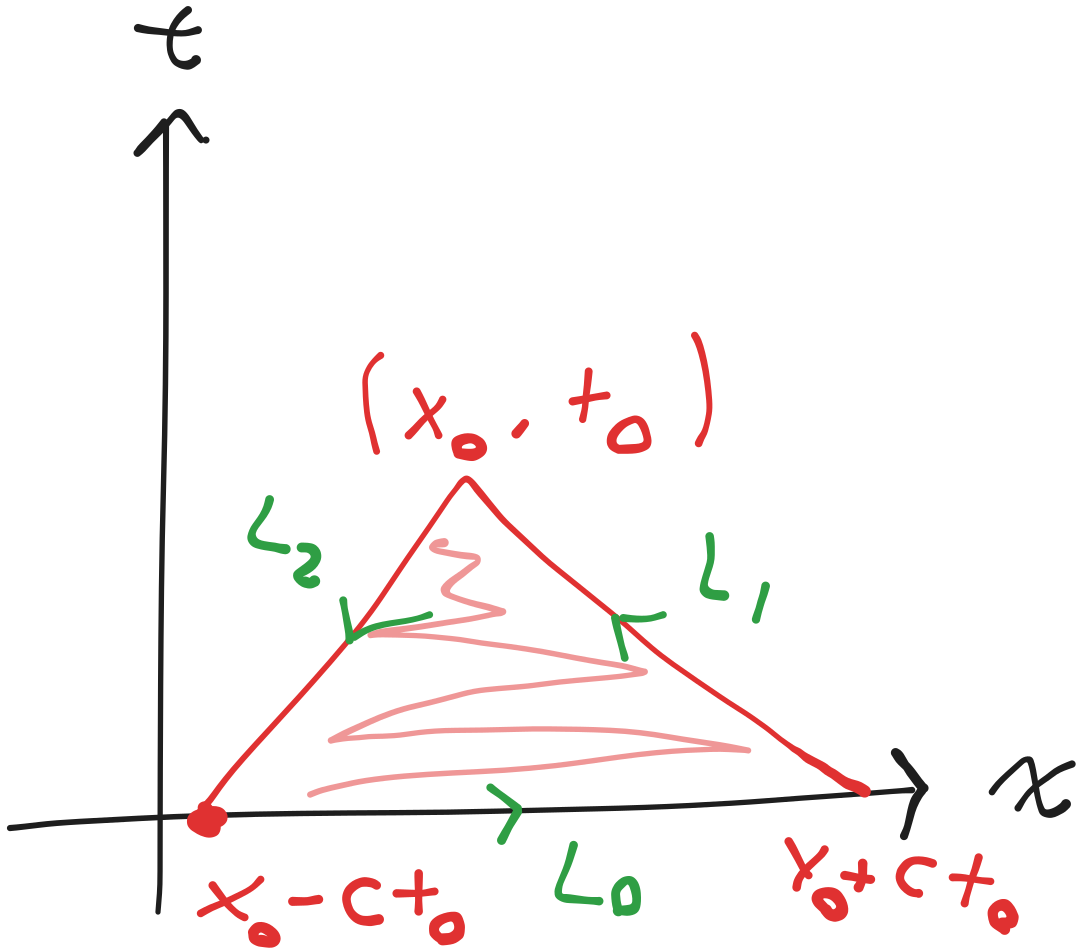
where
\def\arraystretch{1.25} \begin{array}{ccl} L_0 &=& \Set{(a,0) : x_0 - ct_0 \leq a \leq x_0 + ct_0} \\ L_1 &=& \Set{(a,b) : a+cb = x_0+ct_0, \enspace 0 \leq b \leq t} \\ L_2 &=& \Set{(a,b) : a-cb = x_0-ct_0, \enspace 0 \leq b \leq t} \\ \end{array}Thm. Generalized d'Alembert's Formula
Let
u_{tt} - c^2 u_{xx} = f(x,t)be an inhomogeneous wave equation with the initial conditions
\def\arraystretch{1.25} \begin{array}{ccc} u(x,0) &=& g(x) \\ u_t(x,0) &=& h(x) \\ \end{array}then the solution is given by the formula
\def\arraystretch{2.5} \begin{array}{rll} u(x,t) = & \dfrac{g(x+ct) + g(x-ct)}{2} \\ + & \dfrac{1}{2c} \displaystyle \int_{x-ct}^{x+ct} h(s) \> ds \\ + & \dfrac{1}{2c} \displaystyle \int_0^t \int_{x-c(t - \tau)}^{x+c(t - \tau)} f(s,\tau) \> ds \> d\tau \end{array}notice that the double integral is over the characteristic triangle \Delta.
Moreover, if this problem on the half line i.e. with extra boundary condition
u(0,t) = r(t)then the solution is the same as above for x > ct > 0, but for 0 < x < ct, we have
u(x,t) = \cdots \textcolor{red}{ + r\left(t - \dfrac{x}{c}\right) + \dfrac{1}{2c} \iint_D f}where t - x/c is the reflection point and D is the corresponding shaded region.
Thm. Causality
Effect of initial position g(x) is a pair of waves traveling in either direction at speed c and at half the original amplitude. The effect of an initial velocity h(x) is a wave spreading out at speed \le c in both directions, so part of the wave may lag behind (if there is an initial velocity) but no part goes faster than speed c. This is called the principle of causality.
See and add principle of causality figure p. 39
Thm. Domain of Influence and Dependence
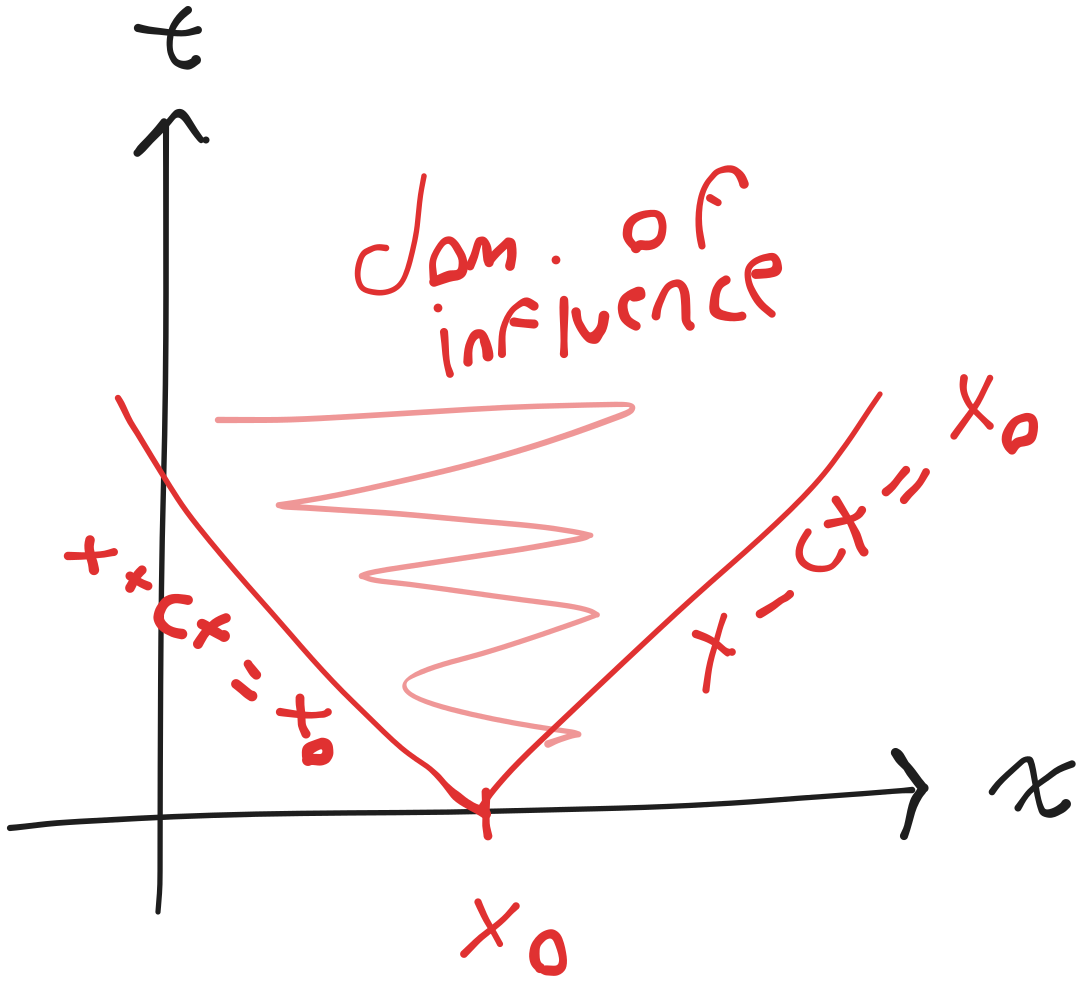
An initial condition (position or velocity or both) at the point (x_0, 0) can affect the solution for t > 0 only in the shaded sector, which is called the domain of influence of the point (x_0, 0). The domain of influence corresponds to the shaded are for the (upwards infinite) triangle defined by two lines x+ct = x_0, x - ct = x_0 and the point (x_0,0) where x_0 \in [x-ct, x+ct].
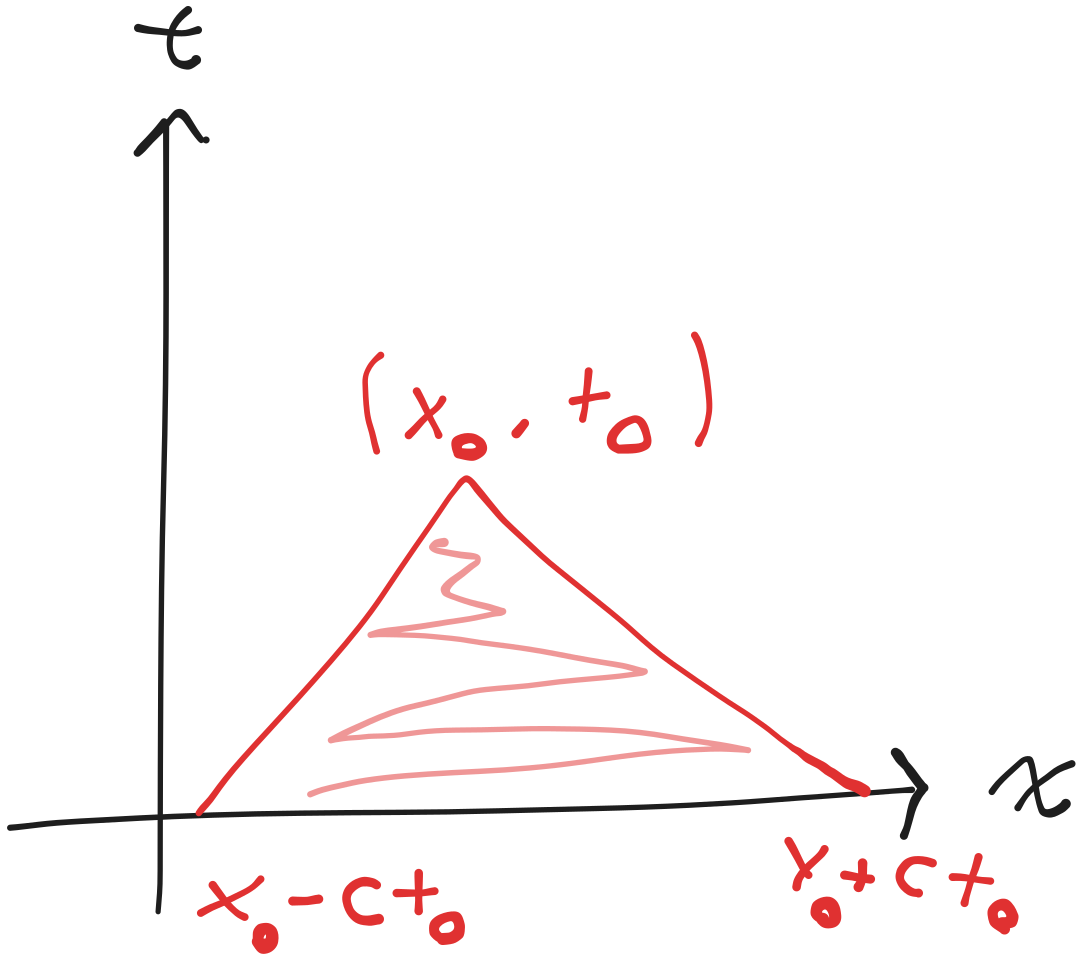
The domain of dependence or the past history of the point (x_0,t_0) corresponds to the shaded area for the (downwards) triangle (x_0-ct_0, 0), (x_0+ct_0,0) and (x_0,t_0) called the characteristic triangle.
Def. Energy
Consider a homogenous wave equation, then we define the energy integral as
\boxed{ E(t) := \dfrac{1}{2} \int_{-\infty}^\infty (u_t^2 + c^2u_x^2) \> dx }which is constant (exercise).
Thm. Reflection of Waves
Assume we are given a Dirichlet problem on the half-line (0,\infty) for the wave equation so that
\def\arraystretch{1.5} \begin{array}{rcl} v_{tt} - c^2 v_{xx} &=& 0 \\ \hdashline v(x, 0) &=& g(x) \\ v_t(x, 0) &=& h(x) \\ \hdashline v(0, t) &=& 0 \end{array}where x \in (0,\infty) and t>0. Then, the solution for x>ct is given by
v(x,t) = \dfrac{1}{2}\bigl(g(x+ct) + g(x-ct)\bigr) + \dfrac{1}{2c} \int_{x-ct}^{x+ct} h(y)\,dyand for 0<x<ct we have
v(x,t) = \dfrac{1}{2}\bigl(g(x+ct) - g(ct-x)\bigr) + \dfrac{1}{2c} \int_{ct-x}^{ct+x} h(y)\,dySee Figure 2 in p. 62
Thm. Duhamel's Principle
TODOs
- Add semi infinite: free/fixed end wave equations and their domains.
- Solution of non-homogenous wave equations via u = v+w, see notes p52.
The Heat Equation
Def. Heat Equation
The (one-dimensional) heat equation is defined as the (parabolic) equation:
\begin{equation} u_t - k^2 u_{xx} = 0 \end{equation}where unless otherwise stated
\def\arraystretch{1.5} \begin{array}{rcl} u(x,0) &=& f(x) \\ u(0,t) &=& \alpha(x) \\ u(\ell,t) &=& \beta(x) \\ \end{array}for non-zero \ell, k \in \R and t > 0 with x \in (0, \ell).
It is also known as the heat equation especially in natural sciences. The heat equation is harder to solve than the wave equation, so we will postpone the general solution.
Similar to the wave equation, the heat equation also has an unique stable solution.
Def. Energy
Consider we are given an homogenous diffusion equation, then we define it's energy integral as
\boxed{ E(t) := \dfrac{1}{2} \int_0^\ell u^2 dx }which is non-increasing (exercise) i.e. E(t) < E(0).
Thm. (Weak) Maximum Principle
We first define the open domain \Omega_T in \R as
\Omega_T := \Set{(x,t) : x \in (0, \ell)\>\land\>t \in (0, T)}and
B_T := \partial \> \Omega_Tthen, if u_t - k^2 u_{xx} \leq 0 in \Omega_T, we have
\max_{\overline{\Omega_T}} u = \max_{\overline{B_T}} uSo, if u(x,t) satisfies the diffusion equation in a rectangle, 0 \leq x \leq \ell and 0 \leq t \leq T in space-time, then the maximum value of u(x,t) is attained either initially at t = 0 or on the lateral sides x = 0 or x = \ell.
Indeed there is a stronger version of the maximum principle called the strong maximum principle which asserts the maximum cannot be attained anywhere inside the rectangle but only on the bottom or the lateral sides (unless u is constant). The corners are allowed.
The minimum value has the same property so that it too can be attained only on the bottom or the lateral sides.
In particular assume that u_t - k u_{xx} = 0 in \Omega_T, then
\begin{array}{lll} \displaystyle\max_{\overline{\Omega_T}} u &=& \displaystyle\max_{\overline{B_T}} u \\ \displaystyle\min_{\overline{\Omega_T}} u &=& \displaystyle\min_{\overline{B_T}} u \\ \end{array}and
\displaystyle\max_{\overline{\Omega_T}} |u| = \displaystyle\max_{\overline{B_T}} |u|hence
-\displaystyle\min_{\overline{\Omega_T}} u = \displaystyle\max_{\overline{\Omega_T}}\,(-u)Thm. Invariance Properties
The diffusion equation (1) has some basic invariance properties, namely
- The translation u(x - y, t) of any solution u(x,t) is another solution.
- Any derivative u_x, u_t, or u_xx etc. of a solution is another solution.
- A linear combination of solutions is again a solution — linearity.
- An integral of a solution is again a solution.
Thm. Diffusion on the Whole Line
Let us be given the following problem
\def\arraystretch{1.25} \begin{array}{rcl} u_t &=& ku_{xx} \\ u(x, 0) &=& \phi(x) \end{array}where x \in (-\infty, \infty) and t \in (0, \infty). Assuming \phi(\infty) = \phi(-\infty) = 0, we have
\boxed{ S(x,t) = \dfrac{1}{\sqrt{4 \pi k t}} e^{-x^2 / 4kt} }for t > 0. This is called the source function, so that for the solution we have
\boxed{ \def\arraystretch{1} \begin{array}{lll} u(x,t) &=& \displaystyle\int_{-\infty}^\infty S(x - y,t) \phi(y) dy \\ \\ &=& \dfrac{1}{\sqrt{4 \pi k t}} \displaystyle\int_{-\infty}^\infty e^{-(x-y)^2 / 4kt} \phi(y) dy \end{array} }The source function S(x,t) is defined for all real x and positive t. Moreover, S(x,t) is positive and is even in x so that S(-x,t) = S(x,t).
Note that the general solution integral is not usually expressible with the elementary functions, therefore recall that
\text{erf}(x) := \dfrac{2}{\sqrt{\pi}} \int_0^x e^{-p^2} dp
Thm. Comparison of Wave and Diffusion
| Property | Wave | Diffusion |
|---|---|---|
| Speed of Propagation | Finite and \leq c | Infinite |
| Singularities for t > 0 | Transported with speed c* | Lost immediately |
| Well-posed for t > 0 | Yes | Yes (at least for bounded) |
| Well-posed for t < 0 | Yes | No |
| Maximum Principle | No | Yes |
| Behaviour as t \mapsto +\infty | Energy is constant so does not decay | Decays to 0 |
| Information | Transported | Lost gradually |
*along characteristics with speed c.
Thm. Diffusion on the Half-Line
Let's take the domain for the diffusion equation to be the half-line (0, \infty) and take the Dirichlet boundary conditions at the single point x = 0, so that the problem becomes
\def\arraystretch{1.5} \begin{array}{rcl} v_{t} - k v_{xx} &=& 0 \\ \hdashline v(x, 0) &=& \phi(x) \\ v(0, t) &=& 0 \end{array}where x \in (0, \infty) and t \in (0, \infty). The general solution for this problem is of the form
\boxed{ v(x,t) = \int_0^\infty \left[ S(x-y, t) - S(x+y, t) \right] \phi(y)dy }Now consider the Neumann problem, so that it becomes
\def\arraystretch{1.5} \begin{array}{rcl} w_{t} - k w_{xx} &=& 0 \\ \hdashline w(x, 0) &=& \phi(x) \\ w_x(0, t) &=& 0 \end{array}where x \in (0, \infty) and t \in (0, \infty), then the general solution for this problem is of the form
\boxed{ w(x,t) = \int_0^\infty \left[ S(x-y, t) + S(x+y, t) \right] \phi(y)dy }Thm. Diffusion with a Source
Let's now consider the diffusion equation with a source f(x,t), i.e.
\def\arraystretch{1.5} \begin{array}{rcl} u_{t} - k u_{xx} &=& f(x,t) \\ \hdashline u(x, 0) &=& \phi(x) \end{array}then the general solution is of the form
\boxed{ \def\arraystretch{1} \begin{array}{lll} u(x,t) &=& \displaystyle\int_{-\infty}^\infty S(x - y,t) \phi(y) dy \\ \\ &+& \displaystyle\int_0^t\int_{-\infty}^\infty S(x-y, t-s) f(y,s) \> dy \> ds \end{array} }Seperation of Variables
Introduction
Consider the space bounded heat equation
\def\arraystretch{1.5} \begin{array}{rcl} u_t - k^2 u_{xx} &=& 0 \\ \hdashline u(x, 0) &=& f(x) \\ u(0, t) &=& 0 \\ u(\ell, t) &=& 0 \end{array}and assume u = X(x)T(t) then by substitution we have
XT' - k^2X'' T = 0 \\and
\dfrac{X''}{X} = \dfrac{1}{k^2} \dfrac{T'}{T} = -\lambda \in \RThey must be equal to a constant since left side depends on x and right side depends on t only. Negativity is for convenience.
for some constant \lambda. This implies two simple ODEs
\def\arraystretch{1.5} \begin{array}{rcl} X'' + \lambda x &=& 0 \\ T'' + k^2 \lambda T &=& 0 \\ \hdashline X(0) = X(\ell) &=& 0 \end{array}This can be considered as an eigenvalue problem. In this case, \lambda \leq 0 implies trivial solutions and for \lambda > 0 we have the set of solutions
\lambda_n = \left(\dfrac{n \pi}{\ell}\right)^2; \> X_n(x) = \sin \left(\dfrac{n \pi}{\ell} x \right)where \lambda_n corresponds to eigenvalues and x_n corresponds to eigenfunctions. Similarly, solving the eigenvalue problem for T yields
T_n(t) = ce^{-\lambda n k^2 t}hence
u_n = X_nT_n = c_ne^{-({n \pi}/{\ell})^2 k^2t} \sin \left(\dfrac{n \pi}{\ell} x \right)so that
u = \sum_{n=1}^{\infty} u_nis a solution (assuming that the series convergent and can be differentiated term by term).
Fourier Series
Def. Hilbert Space
Consider a linear space \cal{H} of piecewise continuous functions on [-\ell, \ell] on space \cal{H}, and define an inner product
\Braket{f,g} = \int_{-\ell}^\ell f(x)g(x)\>dxthen (\cal{H}, \Braket{\cdot, \cdot}) is called a pre-Hilbert space and if \cal{H} is complete it is called a Hilbert Space.
Recall that inner product induces a norm so that
\|f\|_2 = \sqrt{\Braket{f,f}} = \left(\int_{-\ell}^\ell |f|^2 \> dx\right)^{1/2}Thm. An Orthogonal Basis for \cal{H}
The sequence
\left\{1, \cos\left(\dfrac{n \pi}{\ell}x\right), \sin\left(\dfrac{n \pi}{\ell}x\right)\right\}_{n=1}^{\infty}is an orthogonal basis for the pre-Hilbert space \cal{H} and any f \in \cal{H} can be written as
f = \dfrac{a_0}{2} + \sum_{n=1}^\infty \left( a_n \cos\left(\dfrac{n \pi}{\ell}x\right) + b_n\sin\left(\dfrac{n \pi}{\ell} x\right) \right)so that the series converge to f in the norm \| \cdot \|_2.
Thm. Parseval's Equality
Using the basis given above and the norm \| \cdot \|_2, we reach the following identity called the Parseval's Equality:
\boxed{ \| \ell \|^2 = \dfrac{a_0}{2} (2 \ell) + \sum_{n=1}^\infty |a_n|^2 \ell + |b_n|^2 \ell }Note that \|1\|_2 = \sqrt{2\ell} and \|\cos\left(\dfrac{n \pi}{\ell}x\right)\|_2 = \|\sin\left(\dfrac{n \pi}{\ell}x\right)\|_2 = \sqrt{\ell}.
Thm. Fourier Sine Series
Suppose f_\text{odd} piecewise continuous on [-\ell, \ell] and is an odd function, then
f_\text{odd}(x) = \sum_{n=1}^\infty b_n \sin\left(\dfrac{n \pi x}{\ell}\right)in the interval (-\ell, \ell) and is called the Fourier Sine Series for the function f_\text{odd}.
These series, as we saw earlier, are used for wave and diffusion equations with Dirichlet boundary conditions.
Moreover, the coefficients b_n are given by:
\boxed{ b_n = \frac{2}{\ell} \int_0^\ell f_\text{odd}(x) \sin\left(\dfrac{n \pi x}{\ell}\right) \> dx }This is equivalent to the Fourier Series of f_\text{odd} since the even cosine terms cancel out in the full Fourier Series.
Thm. Fourier Cosine Series
Suppose f_\text{even} piecewise continuous on [-\ell, \ell] and is even, then
f_\text{even}(x) = \frac{1}{2}a_0 + \sum_{n=1}^\infty a_n \cos\left(\dfrac{n \pi x}{\ell}\right)in the interval (-\ell, \ell) and is called the Fourier Cosine Series for the function f_\text{even}.
These series, as we saw earlier, are used for wave and diffusion equations with Neumann boundary conditions on (0, l).
Moreover, the coefficients a_n are given by:
\boxed{ a_n = \frac{2}{\ell} \int_0^\ell f_\text{even}(x) \cos\left(\dfrac{n \pi x}{\ell}\right) \> dx }This is equivalent to the Fourier Series of f_\text{even} since the odd sine terms cancel out in the full Fourier Series.
Thm. Fourier Convergence Theorem
Let f be a function on [-\ell, \ell], and extend it periodically with period 2\ell, so that outside [-\ell, \ell] we have
f(x + 2\ell) = f(x).Suppose f is piecewise smooth on [-\ell, \ell], then the fourier series of f converges at each point x to
\dfrac{f(x^+) + f(x^-)}{2}This implies geometrically, for the endpoints of the periodically extended f, the Fourier series converge to their midpoint.
Moreover if f is continuous on [-\ell, \ell] and the endpoint values match periodically i.e.
f(-\ell) = f(\ell)then there is no jump at the endpoints.
Ex. \cal{F}(1)
For some problems it is often useful to consider the Fourier series of the constant 1, which equals to
\cal{F}(1) = \sum_{n=1}^\infty b_n \sin(ny)where
\def\arraystretch{1.25} b_n = \begin{cases} {4}/{(\pi n)} &\text{if } n \text{ odd} \\ 0 &\text{otherwise} \\ \end{cases}Elliptic Equations
Def. Laplace Operator
The Laplace operator is a second-order differential operator in the n-dimensional Euclidean space, defined as the divergence of the gradient of f \in C^2(\Omega). Therefore, if f is a twice-differentiable real-valued function, then the Laplacian of f is the real valued function
\Delta f := \nabla^{2} f = \nabla (\nabla f)Moreover, f is called harmonic if \Delta f = 0.
In this section we will consider the Laplace Equation defined by \Delta u = 0, and then the Poisson Equation defined by \Delta u = F(x) with Dirichlet boundary condition:
u |_{\partial\,\Omega} = f(x)and Neumann boundary condition:
\dfrac{\partial}{\partial \vec{n}}u |_{\partial\,\Omega} = f(x)where \vec{n} is the unit outward normal to \partial \Omega.
Recall that
\dfrac{\partial u}{\partial \vec{n}} = \nabla u \cdot \vec{n}We will not prove it however Poission equation has an unique solution in both boundary conditions, and stable making it well-posed.
Thm. Weak Maximum Principle
Let \Omega be a bounded domain in \R^n and u \in C^2(\Omega) \cap C(\overline{\Omega}) and suppose \Delta u \geq 0 in \Omega, then
\max_{\overline{\Omega}} u = \max_{\partial\,\Omega} uand as a result
\min_{\overline{\Omega}} u = \min_{\partial\,\Omega} uMoreover, if \Delta u = 0 in \Omega, then
\max_{\overline{\Omega}} |u| = \max_{\partial\,\Omega} |u|Thm. Laplace Dirichlet Problem in a Rectangle
Consider the rectange R \subseteq \R^2 defined as 0 < x < a and 0 < y < b, and the Laplace Equation
\def\arraystretch{1.5} \begin{array}{rcl} \Delta u = u_{xx} + u_{yy} &=& 0 \\ \hdashline u(x, 0) &=& f_1(x) \\ u(0, y) &=& g_1(y) \\ u(x, b) &=& f_2(x) \\ u(a, y) &=& g_2(y) \\ \end{array}we can write u = u_1 + u_2 + u_3 + u_4 where \Delta u_i = 0 in R where each u_i corresponds to an edge of R.
For simplicity, let us consider just w=u_1 so that we have
u_1(x,0) = f_1 \\ u_1(x,b) = 0 \\ u_1(0,y) = 0 \\ u_1(a,y) = 0 \\and set w = X(x)Y(y) for seperation of variables, which results in
w_n = c_n \sin\left(\dfrac{n \pi}{a} x\right)\sinh\left(\dfrac{n \pi}{a} (y-b)\right)which can be used to construct a formal solution
w = \sum_{n=1}^{\infty} w_nThis is not really a good solution, maybe check out p. 163 of Strauss.
Thm. Poisson's Formula
Let's consider the Dirichlet Problem for a circle which is
\def\arraystretch{1.5} \begin{array}{rcl} \Delta u = u_{xx} + u_{yy} &=& 0, & x^2 + y^2 < a^2 \\ \hdashline u &=& f(\theta), & x^2 + y^2 = a^2 \\ \end{array}within polar coordinates, we have
\begin{array}{rcl} D &=& \Set{(r, \theta) : 0 \leq r \leq a, \enspace \theta \in [0, 2\pi]} \\ \partial D &=& \Set{(r, \theta) : r = a, \enspace \theta \in [0, 2\pi]} \end{array}and
\boxed{u_{xx} + u_{yy} = u_{rr} + \dfrac{1}{r} u_r + \dfrac{1}{r^2}u_{\theta\theta}}so that
\boxed{ u(r, \theta) = \dfrac{a^2 -r ^2}{2\pi} \int_{-\pi}^{\pi} \dfrac{f(\phi)}{a^2 - 2ar\cos(\theta - \phi) + r^2}\>d\phi }Thm. Mean Value Property
Let u be a harmonic function in a disk D, continuous in its closure \overline{D}, then the value of u at the center of D equals to the average of u on its circumference:
u(x_o, y_o) = \dfrac{1}{2 \pi a} \oint_{\partial D} u\>dsGreen's Identities and Function
Thm. Divergence Theorem
Let V \subseteq \R^3 be a compact with piecewise-smooth boundary and F a smooth vector field, then
\boxed{\boxed{\iiint_V \nabla F \> dV = \oiint_{\partial V} \vec{F} \cdot \vec{n} \> dS}}where \vec{n} is the outward pointing unit normal on the boundary \partial V.
Thm. Green's First Identity
Let \Omega \subseteq \R^n be a domain where the divergence theorem holds and u,v \in C^2(\Omega) \cap C^1(\overline{\Omega}), then
\nabla \cdot (v \nabla u) = \nabla v \nabla u + v \Delta uand by the divergence theorem we get the Green's First Identity:
\boxed{\boxed{ \oint_{\partial \Omega} v \cdot \dfrac{\partial u}{\partial \vec{n}}\>ds = \int_\Omega (\nabla v \nabla u + v\Delta u) \>dV }}Notice that for v = 1, we have
\boxed{ \int_\Omega \Delta u \> dV = \oint_{\partial \Omega} \dfrac{\partial u}{\partial \vec{n}}\>ds }Recall that
\dfrac{\partial u}{\partial \vec{n}} = \nabla u \cdot \vec{n}
Notice how the last identity implies the necessary condition for the existence of solution to the Laplace equations:
\oint_{\partial \Omega} \dfrac{\partial u}{\partial \vec{n}}\>ds = 0Appendix 1. Calculus
Def. Uniform Convergence
We say a functional series \sum_{n=1}^\infty f_n(x) converges uniformly on [a,b] if
\forall \epsilon > 0 \enspace \exists N \enspace \forall k > N \quad \left|\sum_{n \neq k}^{\infty} f_n(x) \right| < \epsilon \quad \forall x \in [a,b]Appendix 2. Separation of Variables and the Dirichlet Condition
Thm. in the Wave Equation
Assume we are given a homogeneous wave equation with Dirichlet conditions so that
\def\arraystretch{1.5} \begin{array}{rcl} u_{tt} - c^2 u_{xx} &=& 0 \\ \hdashline u(0, t) &=& 0 \\ u(\ell, t) &=& 0 \\ \hdashline u(x, 0) &=& g(x) \\ u_t(x,0) &=& h(x) \end{array}where x \in (0, \ell). A separated solution is a solution of the form
u(x,t) = X(x) T(t)So if we plug this equation into our PDE, we get
XT'' = c^2 X'' T \implies -\dfrac{T''}{c^2 T} = -\dfrac{X''}{X} = \lambda.This defines a separation constant \lambda. For the Dirichlet eigenvalue problem one gets \lambda>0, so write \lambda=\beta^2 with \beta>0. Then the equations above are a pair of separate ODEs:
\begin{array}{lcl} X'' + \beta^2 X &=& 0 \\ T'' + c^2 \beta^2 T &=& 0 \end{array}These ODEs are easy to solve and have solutions of the form
\begin{array}{lcl} X = C \cos(\beta x) + D \sin(\beta x) \\ T = A \cos(\beta c t) + B \sin (\beta c t) \end{array}where A,B,C,D are constants. The boundary conditions require X(0)=0=X(\ell). From X(0)=0 we get C=0, hence X(x)=D\sin(\beta x), and then
0 = X(\ell) = D \sin (\beta \ell)We are not interested in the trivial solution X\equiv 0 (equivalently C=D=0).
therefore \beta = \dfrac{n\pi}{\ell} and there are infinitely many separated solutions of the form
\boxed{ u_n(x,t) = \left(A_n\cos\left(\dfrac{n \pi ct}{\ell}\right) + B_n\sin\left(\dfrac{n \pi ct}{\ell}\right)\right)\sin\left(\dfrac{n \pi x}{\ell}\right) }where n = 1,2,\dots and A_n and B_n are arbitrary constants. Noting a sum of solutions is also a solution, we have
\boxed{ u(x,t) = \sum_{n=1}^\infty u_n(x,t) }The coefficients n \pi c / \ell before the variable t are sometimes called the frequencies.
For the initial condition, notice that
g(x) = \sum_{n=1}^\infty A_n \sin\left(\dfrac{n \pi x}{\ell}\right)and
h(x) = \sum_{n=1}^\infty \dfrac{n \pi c}{\ell} B_n \sin\left(\dfrac{n \pi x}{\ell}\right).The numbers \lambda_n = (n \pi / \ell)^2 are called eigenvalues and the functions X_n(x) are called eigenfunctions where n = 1,2,3,....
Thm. in the Diffusion Equation
Analogously assume we are given a homogeneous diffusion equation with Dirichlet conditions so that
\def\arraystretch{1.5} \begin{array}{rcl} u_{t} - k u_{xx} &=& 0 \\ \hdashline u(0, t) &=& 0 \\ u(l, t) &=& 0 \\ \hdashline u(x, 0) &=& g(x) \end{array}where x \in (0, l), then
\dfrac{T'}{kT} = \dfrac{X''}{X} = -\lambdaso that
\boxed{ u(x,t) = \sum_{n=1}^\infty A_n e^{-(n \pi / \ell)^2 kt} \sin\left(\dfrac{n \pi x}{\ell}\right) }and
g(x) = \sum_{n=1}^\infty A_n \sin\left(\dfrac{n \pi x}{\ell}\right).Appendix 3. Separation of Variables and the Neumann Condition
Thm. in the Wave Equation
Consider the (homogenous) wave equation with the Neumann BC, then it has a solution of the form
\def\arraystretch{1.5} \begin{array}{rcl} u_{tt} - c^2 u_{xx} &=& 0 \\ \hdashline u_{\textcolor{red}{x}}(0, t) &=& 0 \\ u_{\textcolor{red}{x}}(l, t) &=& 0 \\ \hdashline u(x, 0) &=& g(x) \\ u_t(x,0) &=& h(x) \end{array}where x \in (0, l). A separated solution for this Neumann BC is a solution of the form
\boxed{ \def\arraystretch{1} \begin{array}{rcl} u(x,t) &=& \dfrac{1}{2}A_0 + \dfrac{1}{2} B_0 t \\ \\ &+& \displaystyle\sum_{n=1}^\infty \left(A_n \cos\left(\dfrac{n \pi c t}{l}\right) + B_n \cos\left(\dfrac{n \pi c t}{l}\right)\right) \cos\left(\dfrac{n \pi x}{l}\right) \end{array} }Thm. in the Diffusion Equation
Now assume we are given a homogeneous diffusion (heat) equation with Neumann conditions so that
\def\arraystretch{1.5} \begin{array}{rcl} u_{t} - k u_{xx} &=& 0 \\ \hdashline u\textcolor{red}{_x}(0, t) &=& 0 \\ u\textcolor{red}{_x}(l, t) &=& 0 \\ \hdashline u(x, 0) &=& g(x) \end{array}then it has a solution of the form
\boxed{ u(x,t) = \dfrac{1}{2} A_0 + \sum_{n=1}^\infty A_n e^{-(n \pi / l)^2 k t} \cos\left(\dfrac{n \pi x}{l}\right) }where
g(x) = \dfrac{1}{2} A_0 + \sum_{n=1}^\infty A_n \cos\left(\dfrac{n \pi x}{l}\right)Also, notice that we have the eigenvalues
0,\; \left(\frac{\pi}{l}\right)^2,\; \left(\frac{2\pi}{l}\right)^2,\;\dotsand the eigenfunctions
X_n(x) = \cos\left(\dfrac{n \pi x}{l}\right)for n=0,1,2,\dots (with X_0\equiv 1).
Notice how, unlike Dirichlet condition, n starts from 0 instead of 1.