Group Theory
Preliminaries
Introduction
- In these notes, unless otherwise stated, all sets are considered to be proper sets as in ZFC.
- Basic (at least naive) set theory and simple combinatorics knowledge is assumed. Other than that, notes should be self-sufficient.
At the moment, these notes have a formal and reference-book like approach except these grayed out notes. I plan more intuition baked in for these notes, with much more visuals, examples and geometry involved.
Resources Used
- Algebra by Thomas W. Hungerford
- Fundamentals of the Theory of Groups, translated second Russian Ed., by M.I. Kargapolov and Ju.I. Merzljakov
- Group Theory Exercises and Solutions by Mahmut Kuzucuoğlu
- Graduate Algebra Problems with Solutions by Mahmut Kuzucuoğlu
- Abstract Algebra, 3rd Ed., by David S. Dummit and Richard M. Foote
Notation
- 0 \in \N and \N^+ :=\ \N \setminus \{0\}.
- \varnothing denotes the empty set.
- (m,n) denotes the greatest common divisor of m, n \in \N.
- \equiv_m denotes integer equivalence in modulo m.
- Cardinality of a set S is denoted with |S|.
- d_1 \>|\>d_2\>|\>\cdots\>|\>d_r means d_1 divides d_2 divides d_3 etc.
Status
These notes are still under work therefore not complete, also
- there are not many exercises,
- proofs are mostly absent,
- typos are quite possible,
- ordering is generally good but should be improved, and
- more visuals and intuition should be provided.
Groups
Def. Group
A group is an ordered pair (G, \cdot) where G is a set and \cdot is a binary operation on G that satisfies:
Simply, \cdot is a (total) function from G to G. Notice that G is any set, finite or infinite.
- Associativity, that is, for all a,b,c \in G we have (a \cdot b) \cdot c = a \cdot (b \cdot c)
This alone defines a semigroup.
- Identity, that is, there exists e \in G called identity (of G) such that for all a \in G we have a \cdot e = e \cdot a = a.
Until here it defines a monoid where identity is two-sided, namely left and right.
- Inverse, that is, for each a \in G there exists an element (called inverse) b \in G such that a \cdot b = b \cdot a = e.
Noting that the identity of a group and the inverse of an element in that group is always unique (exercise) we will denote the inverse of an element a with a^{-1} unless it is abelian.
A group is called abelian (or commutative) if its elements commute, that is, if for all a,b \in G we have a \cdot b = b \cdot a. For abelian groups, we may prefer the additive notation + instead of \cdot for the binary operation and denote the inverse with -a instead.
We might also consider the group as a triplet with identiy (G,\cdot, e) as it is not clear otherwise what is the identity explicitly.
Remarks
The definition (or axioms) given above are not minimal. For example, it's enough to just accept right-identity and right-inverse for it to be group. Using just these two, you can later prove it also holds for the left-identity and left-inverse with the help of the associative property.
Associative property by far is the most powerful property of the group. It allows you to write your expression (involving only \cdot) without any parentheses and much more.
Indeed a structure which only satisfies associative property is called a semigroup. A semigroup with identity is called a monoid and a monoid with inverses is called a group.
Thm. Basic Group Properties
Remembering any group is also a monoid and thus a semigroup let (G, \cdot) be a group, then:
- Identity e is unique. The uniqueness of the identity element does not require the use of associativity.
- For each a \in G, inverse of a is unique.
- For each a \in G, we have (a^{-1})^{-1} = a.
- For all a,b \in G, we have (a \cdot b)^{-1} = b^{-1} \cdot a^{-1}. Indeed, in general, (a_1 \cdots a_n)^{-1} = a_n^{-1} \cdots a_1^{-1}.
Exercise
Thm. Basic Monoid Properties
If M is a monoid, then
- The identity element of M is unique.
Thm. Semigroup to Group
Let (S, \cdot) be a semigroup, then it is a group if and only if both of the following hold:
- Left-identity exists, and
- Left-inverse exists for each s \in S.
By symmetry, the analogous result holds for rights instead of left.
Thm. Semigroup to Group 2
Let S be a semigroup, then it is a group if and only if for all a,b \in S the equations
\begin{array}{ll} ax = b \\ ya = b \end{array}have solutions in G.
Exercise
Thm. Generalized Associative Law
Let S be a semigroup and a_i \in S. Associative property implies that the expression a_1 \cdot a_2 \cdot \cdots \cdot a_n is the same no matter how the expression bracketed.
Proof
By induction. Exercise.
Similarly one could also prove Generalized Commutative Law for the commutative property.
Def. Order
Let (G, \cdot) be a group and a \in G.
The order of (the group) G is denoted by |G| and is the cardinality of the set G.
The order of (the element) a is denoted by |a| and (if exists) it is the least positive integer n such that x^n = e. If there is no such n, we say the order is infinite.
Order of an element a is sometimes denoted with o(a).
If the order of an element x (or group) is finite, we will denote it with |x| \lt \infty. Moreover, if x^2 = x, then x is called an idempotent element where e is the trivial idempotent element.
We say that a group if torsion-free if every non-identity element has infinite order. If every element of a group has finite order then we say the group is periodic.
If orders of a periodic group are bounded, then the least common multiple of their orders is called the exponent of the group. If the orders of elements of a periodic group are powers of prime p, then we call the group a p-group.
Notation. Subsets
Let G be a group and A,B \subseteq G, then we define
- AB := \Set{ab \in G | a \in A, \> b \in B},
- A^0 := \{e\},
- A^n := AA^{n-1},
- A^{-1} := \Set{a^{-1} \in G| a \in A}.
Notation. The Additive Notation
If the binary operation is written additively, which is mostly the case for abelian groups, we may write:
- 0 for the identity instead of 1 (or e for that matter).
- n a instead of a^n where n \in \Z. Notice that operation between n and a is not the binary operation of our structure but rather "n times a".
We define a^0 (or 0a) as the identity element 1 or 0. Notice that, in additive notation, 0a is not the multiplication by the identity but rather "0 times n" which we define to be the identity 0.
Thm. More Group Properties
Let G be a group, then
- If a^2 = e for all a \in G, then G is abelian. (Such groups are called elementary abelian 2-groups.)
- If |G| is finite and even, then it has an element x of order 2. Moreover, x \in Z(G) that is g^{-1}xg = x for all g \in G.
- If A \subseteq G and g \in G, then |A| = |gA|=|Ag|.
Proof
- Exercise,
- Consider G \setminus \{e\} and the map x \mapsto x^{-1}.
Exercises
#1
Let G be a group and x,y \in G such that xy has finite order k, then |xy| = |yx|.
#2
Let G be a group and A,B \subseteq G such that |A| + |B| \gt |G|, then G = AB.
#3
Let G be a group of finite order and S \subseteq G such that |S| \gt \frac{|G|}{2}, then S^2 = G.
Group Examples
TODO: Add much more examples here with extensive exercises.
Klein 4-Group
See Wikipedia: Klein four-group.
The Klein 4-group can be defined by the group presentation
V := \Braket{a,b | a^2 = b^2 = (ab)^2 = e}.Such group is
- of order 4,
- Abelian,
- all non-identity elements have order 2,
- smallest non-cyclic group,
- isomorphic to Dihedral Group of order 4,
- isomorphic to \Z_2 \oplus \Z_2.
Also note that any group of order 4 is isomorphic to either \Z_4 or \Z_2 \oplus \Z_2.
Dihedral Groups
Symmetric Groups
The Quaternion Group
The \mathbb{Q}_p Group
For p prime, define
\mathbb{Q}_p := \left\{{m}/{p^n} : m,n \in \Z \right\}so that \mathbb{Q}_p is a (torsion-free) abelian group under the usual rational addition.
Exercises
#1
Find the order of the (general linear) group \text{GL}(3, \Z_5).
In General Linear Group, matrix multiplication is the binary operation.
Answer
(5^3 - 1)(5^3 - 5)(5^3 - 5^2)
#2
Prove that \mathbb{Q}_p is not isomorphic to \mathbb{Q}_r for distinct primes p and r.
Exercise
Subgroups
Until now we have explicitly defined and shown which multiplication is to which operator and which identity belongs to which group. From now on, these must be understood from the context. We will prefer little brevity over cumbersome notation.
Def. Subgroup
Let G be a group and non-empty H \subseteq G. The non-empty subset H is called a subgroup if H is again a group under the restriction of G's binary operation. This implies H has the same identity as G under the same binary operation.
Thm. Equivalent Subgroup Definitions
A subset H \subseteq G is a subgroup of G if
- H has the same identity as G,
- For all a,b \in H, we have ab \in H that is HH \subseteq H,
- Every element h \in H has an inverse that is H^{-1} \subseteq H.
To be more compact, non-empty H \subseteq G is called a subgroup if and only if (exercise):
- For all a,b \in H we have ab^{-1} \in H.
From now on, we will denote by H \leq G that H is a subgroup of G, moreover H \lt G if H \neq G. The latter is called a proper subgroup of G.
Any group has two subgroups called the trivial subgroup which consists of only the identity and the group itself.
Convention regarding to this trivial and proper notation differs from author to author — we will stick to this naming.
Example. Some Subgroups
- Under addition, \Z \lt \mathbb{Q}_p, \lt \mathbb{Q} \lt \R \lt \Complex,
- Under addition, \Z = \bigcap \mathbb{Q}_p,
- \mathbf{GF}(p^m) \leq \mathbf{GF}(p^n) if m \mid n where \mathbf{GF}(p^m) is the appropriate subset of the algebraic closure of \mathbf{GF}(p).
- Under multiplication, \Z^* \lt \mathbb{Q}^*, \lt \R^* \lt \Complex^*,
- Under multiplication, \Complex_p^* \lt \Complex_{p^2} \lt \cdots \lt \Complex_{p^\infty},
- \Complex_{p^\infty} = \bigcup \Complex_{p^n},
- \mathbf{GF}(p^m)^* \leq \mathbf{GF}(p^n)^* if m \mid n.
- The subset A_n of all even permutations forms a subgroup called the alternating group of degree n, and |A_n|=n!/2.
Thm. Finite and Closed Subset
Let G be a group and S a non-empty subset of G. If S is finite and closed under the group product, then S is a subgroup of G.
So, we don't even need the inverse condition if S non-empty and finite.
Sketch of Proof
We have e \in G since a^n must repeat. Similarly, for inverse we have a^r = a^s implies a^{r-s} = e implies a^{r-s-1}=a^{-1} where r > s \geq 1.
Thm. Intersection of Subgroups
Let \{H_i\} be any non-empty family of subgroups of G, then \bigcap H_i is also a subgroup of G.
Exercise
Thm. Subgroups Under Multiplication
Let G be a group and H,K \leq G, then
- HH = H and H^{-1} = H, thus obviously
- HH^{-1} = H,
- HK is a subgroup of G if and only if HK=KH, and
Exercise
Def. Complement
Let H \leq G. We say K is a complement of a subgroup H if
- G = HK, and
- H \cap K = \{e\}.
Noting KH=HK, this complement relation is symmetrical.
Thm. Basic Complement Properties
- Complements need not to exists, and if they exists they need not to be unique.
Let H and K be complements in G, then
- Every element of G has an unique expression as a product hk or k'h' where h,h' \in H and k,k' \in K.
- K forms both left and right transversal of H for the cosets of H.
Proof
TODO:
Def. Maximal Subgroup
Let G be a group and let H be a proper subgroups of G. We say H is a maximal subgroup if H \subseteq K implies K = H for all K \lt G.
Simply, H is maximal if there is no greater proper subgroup which contain it.
Def. Frattini Subgroup
Let G be a group. We define frattini subgroup \Phi(G) as the intersection of all maximal subgroups of G. In the case G has no maximal subgroups, we define \Phi(G) = G.
This is analogous to the Jacobson radical in the ring theory.
Thm. Frattini Subgroup and Non-Generators
The frattini subgroup \Phi(G) of a group G is equal to the set of all non-generators of G. Therefore, non-generators of a group form a subgroup — namely the frattini subgroup.
Exercises
#1
Let H \leq G and g \in G such that |g| = n and g^m \in H where (m,n) = 1, then g \in H.
Help
Use Bézout's identity.
#2
Let G be a group and g \in G such that |g| = n_1 n_2 where (n_1, n_2) = 1, then there exists g_1, g_2 \in G such that
- g = g_1 g_2 = g_2 g_1, and
- |g_1| = n_1 and |g_2| = n_2.
#3
Let H,K \leq G such that Hx = Ky for some x,y \in G, then H=K.
#4
Let H \leq G and x, y \in G, then Hx = Hy if and only if x^{-1}H = y^{-1}H.
Homomorphisms
Def. Homomorphism
Let (G, \cdot_G) and (H, \cdot_H) be semigroups.
The (total) function (or map) \varphi: G \to H is called a homomorphism if, for all a, b \in G:
\varphi(a \cdot_G b) = \varphi(a) \cdot_H \varphi(b)Mostly, we will not be as explicit about the operations and simply write \varphi(ab)=\varphi(a)\varphi(b) instead.
The homomorphism \varphi is called:
- an monomorphism if it is injective,
- an epimorphism if it is surjective,
- an isomorphism if it is bijective.
- an endomorphism if G=H, and
- an automorphism if it is an endomorphism and bijective.
Composition of homomorphisms is again a homomorphism. Respectively, this is also the case for monomorphisms, epimorphisms, isomorphisms and automorphisms.
For example, if A is abelian, then the map a \mapsto a^{-1} is an automorphism, and the map a \mapsto a^2 is an endomorphism.
Def. Kernel
If \varphi: G \to H is a group homomorphism, then the kernel of \varphi is defined as
\text{Ker }\varphi := \Set{g \in G | \varphi(g) = e_H}.Notation. Homomorphisms
We say semigroups G and H are isomorphic denoted with G \cong H if there exists an isomorphism between them.
Let \phi: G \to H be a group homomorphism g \in G and A \subseteq G, then
- g^\phi denotes \phi(g), and
- A^\phi denotes \phi(A) called the homomorphic (respectively monomorphic, epimorphic, ...) image of A.
Thm. Basic Homomorphism Properties
Let \varphi: G \to H be a group homomorphism, then
- \varphi(e_G) = e_H. This is not necessarily true for monoid homomorphisms!
- \varphi(g^{-1}) = \varphi(g)^{-1} for all g \in G,
- \varphi(g^n) = \varphi(g)^n for all g \in G and n \in \Z,
- \text{Ker }\varphi \leq G,
- \text{Im }\varphi := \varphi(G) \leq H
Exercise
Def. Basic Kernel Properties
Let \varphi: G \to H be a group homomorphism, then
- \varphi is a monomorphism if and only if \text{Ker } \varphi = \{e_G\}.
- \varphi is an isomorphism if and only if there exists an homomorphism \varphi^{-1}: H \to G such that \varphi \varphi^{-1} = \text{id}_G.
Exercise
Def. Endomorphisms
Let G be a group and \text{End } G the set of all endomorphism on G, then \text{End } G is a semigroup under composition. Moreover, if G is a abelian, \text{End } G is a ring with pointwise function addition that is, for \alpha, \beta \in \text{End } G
(\alpha + \beta)(x) = \alpha(x) + \beta(x) \qquad x \in GExercise
Def. Automorphisms
The set of automorphisms on G denoted by \text{Aut }G is a group under function composition. Moreover, \text{Aut }G \leq \mathbf{S}(G) where \mathbf{S}(G) is the group of permutations on G.
Exercise
Exercises
#1
A is abelian group if and only if the map a \mapsto a^{-1} is an automorphism.
#2
Let \alpha: G \to G be a group automorphism and x \in G, then |\alpha(x)| = |x|.
#3
Let \alpha \in \text{Aut}(G) and H = \Set{g \in G | \alpha(g) = g}. Show that H, which is called the fixed point subgroup of G under \alpha is indeed a subgroup of G.
Generators
Def. Generators
From now on, for a group G and a subset A \subseteq G, we will denote by L(G, A) the set of all subgroups of G that contain A. In particular, L(G) denotes the set of all subgroups of G.
Noting that intersection of any collection of subgroups are again a subgroup, we define for any set M \subseteq G, the subgroup generated by M, denoted \Braket{M}, as the intersection of all subgroups which contain M. That is
\Braket{M} := \bigcap_{H_i \> \in \> L(G, M)} H_iElements of M are called the generators of the subgroup \Braket{M}. If M is finite, then we say \Braket{M} is finitely generated.
From now on, when we use set builder notation, instead of \Braket{\Set{x_1, x_2, ... \in X | \cdots}} we will omit the parentheses and simply write \Braket{x_1, x_2, ... | \cdots}.
An element is called a non-generator of a group G if it can be omitted from every generating set for G.
Generally, this definition of a generated subgroup is not really easy to work with. So equivalently...
Thm. Equivalent Generation Definition 1
If M is a subset of a group G, then
\Braket{M} = \Set{a_1^{\epsilon_1} \cdots a_k^{\epsilon_k} \> | \> a_i \in M, \epsilon_i = \pm 1, k = 1, 2, \dots }.Thm. Equivalent Generation Definition 2
Let G be a group and M \subseteq G, then
\Braket{M} = \Set{a_1^{n_1} \cdots a_k^{n_k} \> | \> a_i \in M \text{ and } k,n_i \in \Z }.That is, \Braket{M} consists of all finite products of a_1^{n_1} \cdots a_k^{n_k}.
Therefore, in particular \Braket{x} = \Set{x^n | n \in \Z}. We will inspect these structures in detail in the next chapter.
Proof
TODO:
Def. Join of Subgroups
Let H_i be subgroups of G, then their join is defined as \Braket{\> \bigcup H_i \>} or, if finitely many, as \Braket{H_1, ..., H_n}. The join of two subgroups H,K will simply be denoted as H \lor K.
This notation will make sense later on when we define lattices over groups.
Example. Generator Examples
- \Z = \Braket{1},
- \Z_n = \Braket{\bar{1}},
- \mathbb{Q} = \Braket{\dfrac{1}{n} \mid n = 1,2,\dots},
- \Z^* = \Braket{-1},
- \mathbb{Q}^* = \Braket{-1, 2, 3, 5, 11, \dots},
Cyclic Groups
This section contains important counting theorems (not just for cyclic or abelian groups); hence, it is important to be familiar with every proof in this exercise.
Def. Cyclic Group
A group H is called cyclic group, or simply cyclic, if H can be generated by a single element. That is, there exists an element x \in H such that H = \Braket{x} = \Set{x^n \mid n \in \Z}. Such x is called the generator of H or H is generated by x.
Since cyclic groups are abelian (exercise), additive notation may also be used. In that case, x^n becomes nx.
Notice that the order of the element x and the group \Braket{x} are the same.
Thm. Basic Element Order Properties
Let G be any group and a \in G, then
In the case |a| is not finite,
- a^k = e if and only if k = 0,
- each a^k is distinct for k \in \Z.
In the case |a| = n \in \N^+,
- n is the least positive integer such that a^n = e,
- a^k = e if and only if n\>|\>k,
- a^r = a^s if and only if r \equiv_n s,
- for each k\>|\>n, we have |a^k| = \frac{n}{k}.
Exercise
Thm. Basic Cyclic Properties
Let H be a cyclic group, then
- H is also abelian. So, cyclic implies abelian!
- If x is a generator of H, then so is x^{-1}.
- If x is a generator of H, then |H| = |x|.
Thm. Fundamental Order Property
Let G be a group, g \in G, and m,n \in \Z. If x^m = e and x^n = e, then x^d = e where d=(m,n).
In particular, for any m such that x^m = e, we have |x| divides m.
Proof
By Euclidean Algorithm...
Thm. Every Subgroup of \Z is Also Cyclic
Noting subgroup of a cyclic is cyclic, let (H, +) \leq (\Z, +). Then, either
- H=\Braket{0} which is the trivial subgroup \{0\}, or
- H=\Braket{m} where m is the least positive integer in H. In this case, H is infinite.
Proof
TODO:
Thm. Same Order Cyclics are Isomorphic
For any two cyclic groups \Braket{x} and \Braket{y}, if their orders are the same, there exists an isomorphism \varphi : \Braket{x} \to \Braket{y}.
Indeed, if they are finite, then the map
\def\arraystretch{1.5} \begin{array}{cc} \varphi: & \Braket{x} \to \Braket{y} \\ & x^k \mapsto y^k \end{array}is well-defined and an isomorphism. Therefore, any finite cyclic group of order n is isomorphic to the cyclic group (\Z_n, +_Z).
If they are infinite, then the map
\def\arraystretch{1.5} \begin{array}{cc} \varphi: & \Z \to \Braket{x} \\ & k \mapsto x^k \end{array}is well-defined and an isomorphism. Therefore, any infinite cyclic group is isomorphic to (\Z, +_\Z).
Proof
TODO:
Thm. Fundamentals of Element Orders
Let G be any group, x \in G and a \in \Z^*, then
- If |x| = \infty, then |x^a|=\infty.
- If |x| = n, then |x^a| = \dfrac{n}{(n, a)}.
Thm. Orders of Commutative Elements
Let G be a group and a and b elements of G whose orders are respectively m and n. If a and b commute, then
- (m,n) = 1 \implies |ab| = |a| \> |b|,
- There exists g \in G such that |g| = \text{lcm}(m,n).
Proof
TODO:
Thm. On Generators of Cyclics
Let H = \Braket{x}, then
- If H is infinite, then x and x^{-1} are the only generators of H.
- If H is finite of order n, then x^k is a generator of H, if and only if (k,n)=1.
Therefore, the number of generators of H equals to \varphi(n) where \varphi is Euler's \phi-function.
Thm. Basic Cyclic Properties
Let H=\Braket{x} be cyclic, then
- Every subgroup of H is also cyclic.
- If H is infinite, then for any distinct non-negative integers a and b, \Braket{x^a} \neq \Braket{x^b}.
- For every integer m we have \Braket{x^m} = \Braket{x^{-m}}. Therefore, every non-trivial subgroup of H...
Thm. Homomorphisms from Cyclics
Let G = \Braket{a} be a cyclic group and H any group, then every homomorphism \varphi: G \to H is completely determined by the element \varphi(a) \in H. In particular, \text{Im }\varphi = \Braket{\varphi(a)}.
Obvious
Thm. Finitely Many Subgroups Imply Finite Group
Any group which has only finitely many subgroups must also be finite.
Proof
Consider the finite set of cyclics \mathcal{C} = \Set{\Braket{x} | x \in G} = \Set{ \Braket{x_1}, \Braket{x_2}, ..., \Braket{x_n}}, rest is easy to show.
Exercises
#1
Let G be a finite group such that it has exactly one maximal subgroup M, then G is cyclic.
Help
Consider a \in G \setminus M and \Braket{a}.
Cosets and Indices
Def. Coset
Let G be a group and H \leq G. Then, for all a \in G the set aH is called a left coset and the set Ha is called a right coset.
Def. Coset Congruence
Let G be a group, H \leq G, and a,b \in G. We say,
- a is left-congruent to b modulo H, denoted by a \equiv_{L} b \enspace (\text{mod } H) when a^{-1}b \in H.
- a is right-congruent to b modulo H, denoted by a \equiv_{R} b \enspace (\text{mod } H) when ab^{-1} \in H,
Thm. Coset Congruence
- The relations \equiv_L and \equiv_R are equivalence relations.
- The left (resp. right) equivalence class of a \in G is the set aH (resp. Ha).
- For all a \in G, cardinalities of the sets Ha, H and aH are the same.
- If G is abelian, then left and right congruence coincide. Moreover, this is also possible if G is not abelian.
Proof
TODO:
Corollary. Coset Congruence
Let G be a group and H \leq G, then
- G is the union of right (respectively left) cosets of H,
- Two right (respectively left) cosets are either disjoint or equal,
- Number of distinct left cosets are equal to number of distinct right cosets.
Def. Index
Let G be group and H \leq G then the index of H in G, denoted |G:H| is the cardinal number of the set of distinct right (or left) cosets of H in G.
Thm. Index Theorem
Let G be a group and K \leq H \leq G, then
|G:K| = |G:H||H:K|Corollary. Lagrange's Theorem
Let G be a group and H \leq G, then the order of H divides the order of G. In general, even if G is infinite
|G| = |G:H| \cdot |H|Corollary. Element Order Divides Group Order
Let G be a group and x \in G, then |x| divides |G|.
Thm. Cauchy's Theorem
Let G be a finite group of order n and p is any prime that divides n. Then G contains an element of order p.
We will prove this useful theorem later on, after Sylow Theorems.
Thm. Poincaré
Every subgroup of finite index m of a group G contains a normal subgroup of G of finite index n divisible by m. Moreover, n divides m!.
Thm. Order of Subgroup Multiplication
Let G be group such that H and K are finite subgroups of G, then
|HK| = \dfrac{|H| \cdot |K|}{|H \cap K|}Thm. 1
Let G be a group and H,K \leq G, then we have |H:(H \cap K)| \leq |G:K|.
Moreover, if |G:K| is finite, then |H:(H \cap K)|=|G:K| if and only if G = KH.
Thm. 2
Let H and K be subgroups of finite index of a group G, then
- |G:H \cap K| is finite,
- |G:H \cap K| \leq |G:H||G:K|, and
- |G:H \cap K| = |G:H||G:K| if and only if G = HK.
Thm. Groups of Prime Order
Let G be a group, then the following are equivalent
- |G| is prime,
- G \neq \Braket{e} and G has no proper subgroups,
- G \cong \Z_p for some prime p.
Notice that (3) implies that every group of prime order is cyclic.
Exercises
#1
Let G be a group and H,K \leq G such that indices of H and K are relatively prime, then G=HK.
Conjugates and Normals
Def. Conjugate
Let G be a group, H \leq G, and a,b \in G, then
- the element aba^{-1} is called the conjugate of a by b,
- the set aHa^{-1} is called the conjugate of H by a,
- the element a is said to normalize H if aHa^{-1} = H.
Note that more general definitions would use only commutativity (that is gh = hg) instead of inverses for semigroups.
We also say a is conjugate to an element b by an element x if a = xbx^{-1} denoted with a = b^x. We further define for sets A, B \subseteq G, and g \in G
\begin{array}{lll} A^B & := & \Set{a^b | a \in A, b \in B} \neq BAB^{-1} \\ A^g & := & gAg^{-1} \end{array}Note that A^B is defined as the set of elements bab^{-1}, not ba(b')^{-1} for some b'.
Thm. Basic Conjugate Properties
Let G a group and a,b,x \in G, then
- (ab)^x = a^x b^x,
- (a^x)^y = a^{xy},
- a=b^x \implies |a| = |b|.
Def. Normal
Let G be a group and N its subgroup. If for all a \in G we have aN=Na, then N is called a normal subgroup (or simply a normal) of G denoted by N \trianglelefteq G.
If N \neq G, then N \vartriangleleft G will also be used to denote N is a proper normal subgroup of G.
From now on, it should be understood from A \trianglelefteq B alone that B is a group and A is its normal subgroup.
Thm. Equivalent Normal Definitions
Let G be a group and N \leq G, then the following are equivalent
- \equiv_L and \equiv_R modulo N coincide,
- gN=Ng,
- N^g = gNg^{-1} \subseteq N for all g \in G, that is N^G \subseteq N,
- N^g = gNg^{-1} = N for all g \in G, that is N^G = N.
Thm. More Normal Properties
- Let M,N \trianglelefteq G. If M \cap N = \{e\}, then mn=nm for all m \in M and n \in N.
- Kernel of any group homomorphism is a normal subgroup.
- If |G:H| = 2, then H \trianglelefteq G.
- A, B \trianglelefteq G implies AB \trianglelefteq G.
- Find normal subgroups A, B, C such that A \trianglelefteq B \trianglelefteq C, but A \not\trianglelefteq C.
Thm. Normal and Subgroup Properties
Recall that the "join" of two subgroup H,K denoted H \lor K is the subgroup \Braket{H \cup K}.
Let N \trianglelefteq G and K \leq G, then
- (N \cap K) \trianglelefteq G, so intersection of any subgroup with a normal is a normal,
- N \lor K = NK = KN, so join of any subgroup with a normal is their product,
- N \trianglelefteq (N \lor K).
TODO: Revise (2) noting that we have defined the multiplication as join! Did we define that?
Def. Simple Group
A group is said to be simple if it has no proper (and non-trivial) normal subgroups.
Exercises
#1
Let G be a group of finite order, N \trianglelefteq G and H \leq G such that |H| is relatively prime to |G:N|, then H \leq N.
#2
Show that (\Z_p, +) is simple if p is prime. Does the converse holds?
Normalizer And Centralizer
Def. Centralizer
Let G be a (sub)group and A a non-empty subset of G, then the centralizer of A in a group G is defined as
C_G(A) := \Set{ g \in G | a^g = a \quad \forall a \in A }Beware that if we were to write A^g = A to the right-hand side it wouldn't be the same definition.
Note that a more general definition would use ga = ag for semigroups.
Def. Center
The center of a (sub)group G denoted with Z(G) is defined as Z(G) := C_G(G).
It is basically the set of all elements in the group that commute with all other elements in the group.
Def. Normalizer
Let G be a group and A a non-empty subset of G. Similar to centralizer (but not necessarily equivalent), the normalizer of A in G is defined as
N_G(A) := \Set{ g \in G | A^g = A}and it is also a subgroup of G.
The definitions of centralizer and normalizer are similar but not identical. If g \in C_G(A) and a \in A, then it must be the case that a^g = a, but if g \in N_G(S), then a^g = a' for some a' \in A, with a' possibly different from a.
Obviously a subgroup is a normal subgroup in a group if and only if its normalizer is the whole group.
This is one reason why the notation gag^{-1} (or a^g) is preferred over ga=ag — unless we working with semigroups of course.
Thm. Basic Properties of Normalizer and Centralizer
Let G be a group, then
- Z(G) \trianglelefteq G
Thm. '
TODO: Revise, define a^G etc.
Let G be a group and a \in G, then
|a^G| = [G:N_G(a)]You may check out Kargapolov p. 16 for a more general version of theorem and the proof.
Notation. Normal Generators
Let H \leq G, then
- H^G denotes the intersection all normals in G that contain H,
- H_G denotes \Braket{H^g | g \in G}.
join and largest normal subgroup contained in H.
Thm. Building Normal from a Subgroup
Let H \leq G, then the set
N = \bigcap_{g \> \in \> G} H^gis a normal subgroup of G. Moreover, N = H_G.
Exercise
Exercise
If G is not abelian, then Z(G) is properly contained in an abelian subgroup of G.
Hint
Consider x \in G \setminus Z(G).
Quotients and Isomorphisms
Def. (Group) Congruence Relation
An equivalence relation \equiv on a group G is called a (group) congruence relation if for all x_1,x_2,y_1,y_2 \in G
x_1 \equiv x_2 \> \land \> y_1 \equiv y_2 \implies x_1y_1 \equiv x_2y_2The product of two congruence classes is again a congruence class. Indeed, the set of all congruence classes G/{\equiv} is a group under the multiplication of classes called the quotient group with respect to \equiv.
Thm. Group Congruences and Normals
The congruence relations on a group G are in one-to-one correspondence with the normal subgroups of G.
Usually quotient groups in group theory are defined via normal groups but this paints a much wider picture. Following this motivation, here is the classical definition of quotient groups.
Def. Quotient Group
Let G be a group and N \trianglelefteq G. The set of all cosets of N in G denoted by G/N (read as G modulo N) forms a group under the binary operation
(aN)(bN)=(ab)Nand is of order [G:N]. This group is called the quotient group (or factor group) of G by N.
Notice how we are not multiplying cosets directly, but rather the elements in front of them.
Thm. Basic Quotient Properties
Let G be a group and N \trianglelefteq G.
- If G is cyclic, then so is G/N.
- G/N is abelian if and only if [G,G] \subseteq N.
Exercise
Def. Projection
Let N \trianglelefteq G, then
\begin{array}{lrll} \pi: & G & \to & G/N \\ & a & \mapsto & aN \end{array}is an epimorphism and \text{Ker }\pi = N. Such \pi is called the canonical epimorphism or (natural) projection of G under N. Therefore, unless otherwise stated, G \to G/N always denotes the natural projection.
If the group is clear from the context, we may make use of the notation \pi_N to denote the projection G \to G/N.
Exercise
Thm. Commutativity of Projection
Let \pi_N be the natural projection of G under N, then G/N is abelian if and only if [G,G] \subseteq N.
Proof
TODO:
Thm. Fundamental Theorem on Homomorphisms
Let \varphi: G \to H be a group homomorphism, N \trianglelefteq G, and N \subseteq \text{Ker }\varphi \trianglelefteq G. Then there exists an unique homomorphism \bar{\varphi} where
\begin{array}{rrll} \bar{\varphi}: & G/N & \to & H \\ & aN & \mapsto & \varphi(a) \end{array}and
- \varphi(G) = \bar{\varphi}(G/N),
- \text{Ker }\bar{\varphi} = (\text{Ker }\varphi) / N
Therefore, \bar{\varphi} is an isomorphism if and only if
- \varphi is an epimorphism, and
- N = \text{Ker }\varphi.
Proof
TODO:
Thm. First Isomorphism Theorem
Let \varphi: G \to H be a group homomorphism, then
- \text{Ker }\varphi \trianglelefteq G, so kernel of any group homomorphism is normal,
- \varphi(G) \leq H, so image of any group homomorphism is a subgroup,
- \varphi(G) \cong G/(\text{Ker }\varphi), so if \varphi is an epimorphism, then H \cong G/(\text{Ker }\varphi).
Proof
TODO
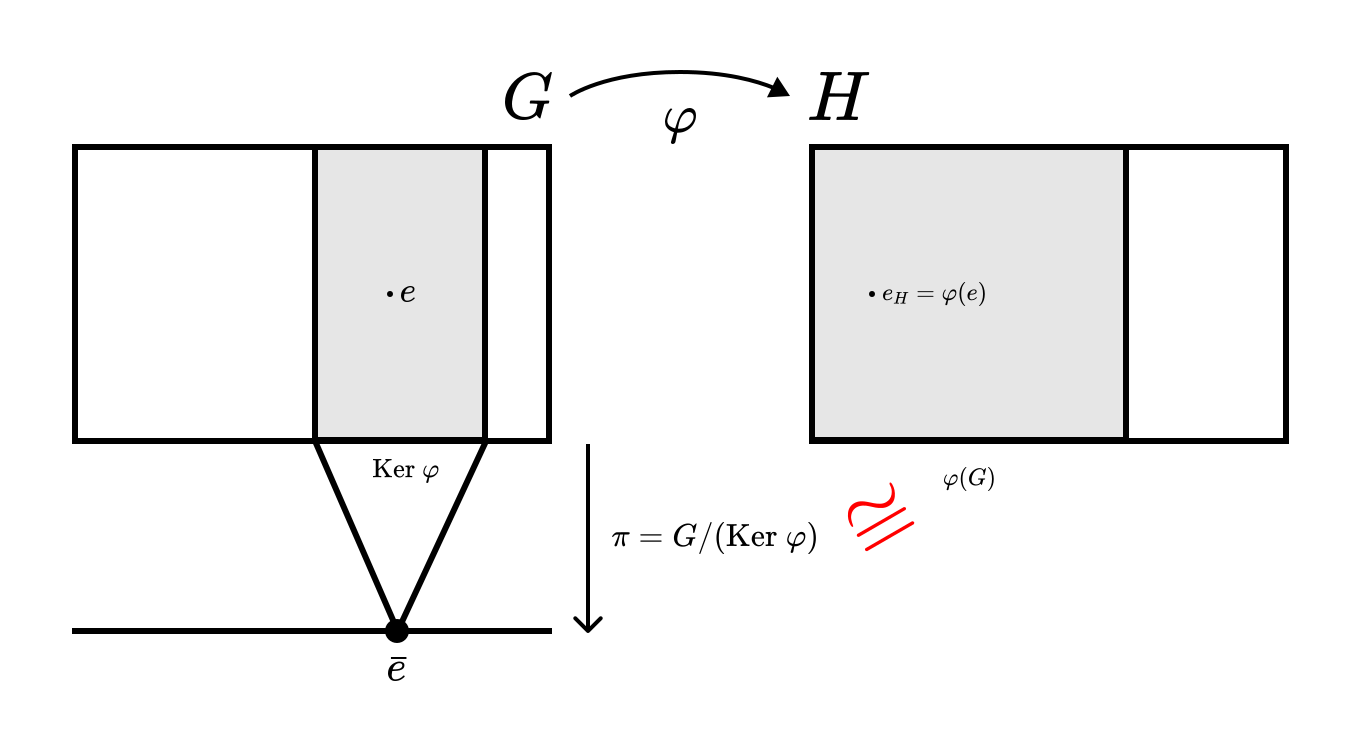
Figure 1. First Isomorphism Theorem
Thm. Second Isomorphism Theorem
This theorem is also called the Diamond Isomorphism Theorem or Parallelogram Theorem due to lattice it draws.
Let G be a group H \leq G and N \trianglelefteq G, then
Recall that since N is normal and H is a subgroup, we have H \lor N = HN = NH.
- N \trianglelefteq HN \leq G,
- H \cap N \trianglelefteq H, and
- HN/N \cong H/(H \cap N).
TODO: (Examine) Technically, N need not to be normal in G, it suffices H to be a subgroup of N_G(N).
Proof
TODO:
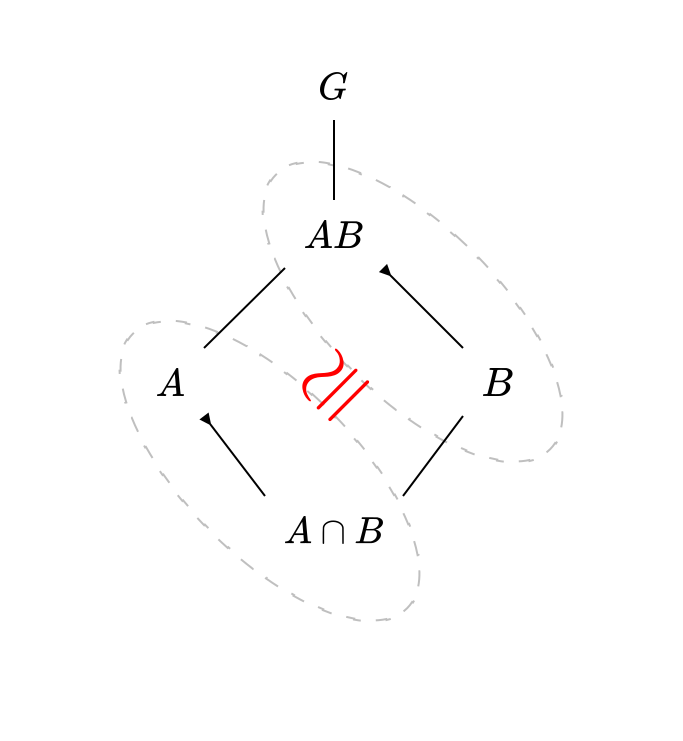
Figure 2. Second Isomorphism Theorem
TODO: Redraw diagram
Thm. Third Isomorphism Theorem
Let K \trianglelefteq H \trianglelefteq G, then
- H/K \trianglelefteq G/K, and
- (G/K)/(H/K) \cong G/H.
Proof
TODO:
Thm. Homomorphism Induced Bijection
Recall that L(G,A) was the set of all subgroups of G which contain the subset A, and L(G) := L(G, e).
Let \varphi: G \to H be a group homomorphism. Then \varphi induces a bijective map
\begin{array}{ll} \psi: L(G, \text{Ker }\varphi) \to L(H) \end{array}such that image of normal subgroups are normal subgroups.
TODO: Proof, omitted.
Corollary. Normal Subgroups of Qutients
Let N \trianglelefteq G, then every subgroup of G/N is of the form K/N where N \subseteq K \leq G. Moreover, K/N \trianglelefteq G/N if and only if K \trianglelefteq G.
Sketch of Proof
Direct implication of the theorem above for the epimorphism \pi_N.
Endomorphisms
Def. Inner and Outer Automorphisms
Let G be a group, a \in G, and \iota_a: G \to G be a map such that x \mapsto x^a, then \iota_a is an automorphism on G called an inner automorphism. Moreover, the set of all inner automorphism on G denoted by \text{Inn }G is a normal subgroup of \text{Aut }G.
An automorphism which is not inner is called an outer automorphism. Noting \text{Inn }G is normal, we define the outer automorphism group as
\text{Out } G := \text{Aut } G / \text{Inn }GThm. Inner Automorphisms
Let G be a group, then
\text{Inn }G \cong G / C(G)Proof
TODO
Def. Endomorphic Invariance
Let H \leq G and \Phi \subseteq \text{End }G. We say H is \Phi-invariant or invariant with respect to \Phi if for all \phi \in \Phi
\phi(H) \leq HNoting that \Braket{e} and G is invariant with respect to any arbitrary \Phi, we say the group is \Phi-simple if it contains no other \Phi-invariants than these two.
Thm. Equivalent Normal Definition
Let H \leq G, then H is normal if and only if H is invariant with respect to \text{Inn }G.
Exercise
Notation. Invariance
Let H \leq G, then we respectively denote \text{End } G, \text{Aut }G, and \text{Inn }G with
- \leq_E or \leq_\text{End},
- \leq_A or \leq_\text{Aut},
- \leq_I or \leq_\text{Inn} which is equivalent to \trianglelefteq as shown above.
Thm. Invariance Transitivity
The relations \leq_\text{End} and \leq_\text{Aut} are transitive.
Exercise
Def. (Strictly) Characteristic Subgroup
Let H \leq G, then we say H is a (strictly) characteristic subgroup of G if H is invariant with respect to \text{Aut }G, that is H \leq_\text{Aut} G.
Def. Fully Characteristic Subgroup
Let H \leq G, then we say H is a characteristic subgroup (or fully invariant subgroup) of G if H is invariant with respect to \text{End }G, that is H \leq_\text{End} G.
Thm. Characteristic Normality
Let H be a characteristic subgroup of G, then H is normal in the whole group, that is A \trianglelefteq N for all N \trianglelefteq G.
Exercise
Def. Complete Group
A group G is called complete if it has trivial center and \text{Aut }G = \text{Inn }G. Therefore,
\text{Aut }G \cong GExercises
#1
The center C(G) of a group G is always characteristic.
#2
The Frattini subgroup of any group is characteristic.
Symmetric Groups
Def. Permutation
A permutation \sigma on a set X is a bijective function from X to X. The permutation x \mapsto x will be called the identity permutation.
We say an element x \in X is fixed under \sigma if \sigma(x) = x. Similarly, we say x is moved by \sigma if \sigma(x) \neq x.
For simplicity, we will use the set \textbf{I}_n = \Set{1, 2, ..., n} instead of any X of any cardinality.
More formally, we could make use of Well-Ordering Principle, initial segments, and ordinals. For now, this definition should suffice.
Def. Support
The support of a permutation \sigma denoted by \text{supp }\sigma is defined as the set of elements that are moved by \sigma, that is
\text{supp }\sigma := \Set{i \in \mathbf{I}_n | \sigma(i) \neq i}.Similarly, the set of fixed elements denoted with \text{fix }\sigma is the set
\text{fix }\sigma := \Set{i \in \mathbf{I}_n | \sigma(i) = i}.Def. Disjoint Permutations
The permutations \sigma_1, \sigma_2, ..., \sigma_n are said to be disjoint if their support is disjoint.
Def. Cycle
Let \tau be a permutation on \mathbf{I}_n with the support \Set{k_1, k_2, ..., k_r}. Then \tau is said to be a cycle (or cyclic) of length r if
\begin{array}{lll} k_1 & \mapsto k_2 \\ k_2 & \mapsto k_3 \\ & \vdots \\ k_r & \mapsto k_1 \end{array}denoted with (k_1 k_2 \cdots k_r).
A cycle of length r will be called a r-cycle. A 2-cycle is called a transposition.
There is no widespread consensus on how to explicitly define a cycle, but the intuition should be clear.
Def. Symmetric Group
Set of all permutations (bijections) on \textbf{I}_n will be denoted with \textbf{S}_n and it forms a group under function composition (exercise) called the symmetric group (of n letters).
Notice that \textbf{S}_n is of order n!.
Thm. Permutations are (Unique) Product of Disjoint Cycles
Every non-identity permutation in \textbf{S}_n is uniquely (up to the order of the factors) a product of disjoint cycles, each of which has length at least 2.
Corollary. Order of Permutation
The order of a permutation is the least common multiple of the orders of its disjoint cycles.
Corollary. Permutations are a Product of Transpositions
Every permutation can be written as a product of (not necessarily unique) transpositions.
Def. Odd and Even
A permutation is said to be even (resp. odd) if it can be written as a product of even (resp. odd) number of transpositions.
Thm. Exclusively Odd or Even
A permutation \sigma \in \textbf{S}_n where n \geq 2 is either even or odd, but not both.
Therefore, the sign of a permutation \sigma denoted \text{sgn } \sigma is defined to be 1 if even and -1 if odd.
Thm. Alternating Group
Let \textbf{A}_n denote the set of all permutations of \textbf{S}_n. Then \textbf{A}_n is a normal subgroup of \textbf{S}_n of index 2. Moreover, \textbf{A}_n is the only subgroup of \textbf{S}_n of index 2.
\textbf{A}_n is called the alternating group (of degree n).
Thm. Galois
The alternating group \textbf{A}_n is simple if and only if n \neq 4.
Lemma. 1
Let r,s \in \mathbf{S}_n where n \geq 3. Then A_n is generated by 3-cycles such that
\Set{(rsk) \mid 1 \leq k \leq n, \> k \neq r,s}Lemma. 2
For n \geq 3, if N \trianglelefteq A_n and N contains a 3-cycle, then N=A_n.
Proofs are skipped for this theorem, curious reader may checkout Hungerford (pp. 49-50) or Kargapolov (pp. 72-74).
Thm. Hölder
The symmetric group \mathbf{S}_n is complete if n \neq 2, 6.
Check out Kargapolov pp. 43-44 for the partial proof.
Thm. Dihedral Group Generators
Let n \geq 3, then the dihedral group \textbf{D}_n (which is of order is 2n) is a group whose generators a and b satisfy
- a^n = b^2 = e and a^k \neq e if 0 < k < n,
- aba = b.
Moreover, for n \geq 3, any group G which is generated by a and b that satisfy (1) and (2) is isomorphic to \textbf{D}_n.
Proof
TODO:
Exercise. Generator of \textbf{D}_n
Let \Braket{a} \leq \textbf{D}_n for a \in \textbf{D}_n and |a|=n, then
- \Braket{a} \trianglelefteq \textbf{D}_n, and
- \textbf{D}_n/\Braket{a} = \Z_2.
Thm. Center of \textbf{D}_n
Let Z be the center of the group \textbf{D}_n, then
- Z = \Braket{e} if n is odd,
- Z \cong \Z_2 if n is even.
Proof
Exercise
Direct Products and Sums
Note that the letter I denotes any index set which is mostly taken to be \N or non-empty initial segment of \N.
Def. Direct Product (of Groups)
This is equivalent to the formal definition of set of tuples from the axiomatic set theory, but for the family of groups instead of family of sets.
Let \Set{G_i} be a family of groups indexed by a non-empty set I, then the direct product (or complete direct sum) of the groups G_i denoted with \prod_{i\>\in\>I} G_i is the set of all functions
f: I \to \bigcup_{i\>\in\>I} G_isuch that f(i) \in G_i. Notice that since each G_i is a group, thus non-empty, we have \prod G_i \neq \varnothing.
As a mental image, think of \prod G_i as the set of all (ordered) tuples where each i-th element belongs to G_i so that each f \in \prod G_i represent a tuple in that set.
Def. Natural Projections
Let \Set{G_i} be a non-empty family of groups, then \prod G_i is a group under component-wise multiplication and for each k \in I, the map
\def\arraystretch{1.2} \begin{array}{lrll} \pi_k: & \prod G_i & \to & G_k \\ & f & \mapsto & f(k) \end{array}called the (natural) projection(s) of the direct product is an epimorphism of groups.
Exercise
Def. (External) Weak Direct Product
Let \Set{G_i} be a non-empty family of groups, then the (external) weak direct product of the groups G_i denoted with \prod^w G_i is the set of all f \in \prod G_i such that f(i) = e_i for all but a finite number of i \in I.
That is, non-identity elements of the tuple f are finite. Tuple consists of "mostly" identity elements.
Notice that if I is finite, then every direct product is a weak direct product.
Moreover, if each G_i is additive (that is abelian) \prod^w G_i is called the (external) direct sum denoted with \sum G_i.
Thm. Normals and Injections
Let \Set{G_i} be a family of non-empty groups, then \prod^w G_i \trianglelefteq \prod G_i, and for each k \in I, the map
\def\arraystretch{1.5} \begin{array}{lrll} i_k: & G_k & \to & \prod^w G_i \\ & a & \mapsto & f = (e_1, ..., e_{k-1}, a, e_{k+1}, ...) \end{array}is a monomorphism of groups. Moreover, for each k \in I, we have i_k(G_k)\trianglelefteq \prod G_i.
Exercise
Thm. Direct Sum and Family of Homomorphisms
Let \Set{A_i} be a non-empty family of abelian groups, and B an abelian group. If \Set{\varphi_i: A_i \to B} is a family of homomorphisms (with the same index set), then there exists an unique homomorphism
\begin{array}{lrll} \varphi: \sum A_i \to B \end{array}such that \varphi \circ i_k = \varphi_k for all k \in I. This property determines \sum A_i uniquely up to isomorphism.
This theorem is false if the groups are not abelian.
Thm. Direct Sum of Normals
Let \Set{N_i} be a non-empty family of normal subgroups of a group G such that
- G = \Braket{\>\bigcup N_i\>}, and
- for each k \in K, we have N_k \cap \Braket{\>\bigcup_{i\>\neq\>k} N_i\>} = \Braket{e}.
Then
G \cong \prod^w N_iand \Set{N_i} is called a normal decomposition of G.
Def. Internal Product
Let \Set{G_i} be a non-empty family of groups and \prod G_i = G. If \Set{G_i} is a normal decomposition of G, then G=\prod G_i is said to be the internal weak direct product (or internal direct sum if G is abelian).
Thm. Normal Decomposition Condition
Let \Set{N_i} be a non-empty family of normal subgroups of G. Then, \Set{N_i} is a normal decomposition of G if and only if for each non-identity g \in G is the unique product
g = a_{i_1}a_{i_2} \cdots a_{i_n}where each i_k \in I is distinct and e \neq a_{i_k} \in N_{i_k} for each k = 1,2,...,n.
Exercise
Thm. Internal Direct Sum and Family of Homomorphisms
Let \Set{\varphi_i: G_i \to H_i} be a family of homomorphism of groups and let
\def\arraystretch{1.5} \begin{array}{lrll} \varphi: & \prod G_i & \to & \prod H_i \\ & (a_i) & \mapsto & (\varphi_i(a_i)) \end{array}Then \varphi is a homomorphism of groups such that
\varphi\left(\prod^w G_i\right) \subseteq \prod^w H_iand
\text{Ker }\varphi = \prod \text{Ker }\varphi_iand
\text{Im }\varphi = \prod \text{Im }\varphi_iMoreover, \varphi is a monomorphism (resp. epimorphism) if each \varphi_i is.
Corollary. Normals and Quotients
Let \Set{G_i} be a non-empty family of groups and \Set{N_i} be a non-empty family of normal subgroups (of same index) such that N_i \trianglelefteq G_i for all i \in I. Then
- \prod N_i \trianglelefteq \prod G_i and {(\prod G_i)}/{(\prod N_i)} \cong \prod (G_i/N_i),
- \prod^w N_i \trianglelefteq \prod^w G_i and {(\prod^w G_i)}/{(\prod^w N_i)} \cong \prod^w (G_i/N_i)
Exercise, use First Isomorphism Theorem.
Free Groups
In this section, we will resort to rather a constructive approach to define free groups.
Def. Free Generator
We say S is a free generator if for each s \in S there exists a corresponding distinct s^{-1} \in S^{-1} called the inverse of s such that S and S^{-1} are disjoint and |S| = |S^{-1}|. Moreover, the identity \epsilon of S is an element such that \epsilon \not\in S \cup S^{-1} whose inverse is itself.
We could have defined the free generator S more formally with tuples and bijective functions, but the notation becomes very cumbersome very quickly. Intuition and the way to formalize it should be clear.
Def. Word
Let S be a free generator, then a word on S is a countably finite sequence (a_1, a_2, ...), indexed by \N^+, where
- a_i \in S \cup S^{-1} \cup \{\epsilon\} for each i \in \N^+, and
- for some n \in \N^+ we have a_k = \epsilon for all k \geq n.
The constant sequence (\epsilon, \epsilon, ...) is called the empty word and denoted with 1.
A word w = (a_1, a_2, ...) is said to be reduced if
- a_i = x \implies a_{i+1} \neq x^{-1} for all i \in \N^+ and x \in S \cup S^{-1}, that is there are no adjacent inverses (other than \epsilon),
- a_k = \epsilon \implies a_i = \epsilon for all i \geq k, that is any identity is followed by an identity.
In particular, every non-empty reduced word is of the form, for some n \in \N^+
(x_1^{\lambda_1}, x_2^{\lambda_2}, ..., x_n^{\lambda_n}, \epsilon, \epsilon, ...)where x_i \in X and \lambda_i = \pm 1. From now on we will omit the parentheses.
Notice that the empty word is reduced and x^1 := x. Reduction algorithm should be obvious.
This is a rather formal definition of a word, simply put a word on X is a finite product of elements X \cup X^{-1} such that inverses cancel each other out where \epsilon is the identity. Now, we should define the binary multiplication on (reduced) words themselves to make it a group.
Def. Free Group
Let non-empty X be a free generator, and let \mathbf{F}(X) be the set of all reduced words on X, then \mathbf{F}(X) is a group under the binary operation where xy is the reduced concatenation for all x,y \in \mathbf{F}(X). The group \mathbf{F}(X) is called the (absolutely) free group on the set X denoted by \Braket{X}. The cardinal number |X| is called the rank of the free group \mathbf{F}(X).
For a more formal definition check out Hungerford pp. 64-65
Do not mistake \Braket{\cdot} here with the notation of cyclic groups or generators.
Notice that the representation \Braket{X \mid R} is isomorphic to \mathbf{F}(X) / \Braket{\Braket{R}}.
One usually denotes a free group of rank n with \mathbf{F}_n or \mathbf{F}_\infty if X is (countably) infinite.
Thm. Universal Property
Let X be a set, \Braket{X} the free group generated by X, and i: X \to \Braket{X} an inclusion map. For G a group and \varphi: X \to G a map of sets (a map without any extra structure), there exists an unique homomorphism of groups \bar{\varphi}: \Braket{X} \to G such that \bar{\varphi} \circ i = \varphi.
Proof
TODO:
Corollary.
Every group G is the homomorphic image of a free group F. In particular, G is isomorphic to the quotient group F/{\text{Ker }\bar{\varphi}}.
Def. Presentation
Let Y \subseteq \Braket{X}, then a group G is said to be defined by the generators x \in X and relations w \in Y provided that N \trianglelefteq \Braket{X} is generated by Y. Noting that G \cong \Braket{X}/N, we say \Braket{X | Y} is a presentation of G.
Moreover, instead of \Braket{X|Y}, we may write \Braket{X|w_1=1, w_2 = 1, ...} for brevity, or even more compactly \Braket{X|w_1, w_2, ...}
We have previously shown such defined group exists and it is the largest possible group in that sense.
Example
\Braket{a,b | a^n = 1 (n \geq 3), b^2 = 1, abab = 1} is a presentation for the dihedral group D_n.
Thm. Van Dyck
Let G = \Braket{X|Y} and H = \Braket{X} such that H satisfies all the relations w = 1 where w \in Y, then there is an epimorphism \psi: G \to H.
Proof
TODO:
Thm. Nielsen-Schreier
Proof of subgroups of free groups are also free was provided for finitely generated free group by J. Nielsen in 1921 and for all any free group by O. Schreier in 1927.
Let G be a free group of rank r and H \leq G, then H is itself isomorhpic to a free group. Moreover, if H is of finite index m, then H is of rank 1 + m(r - 1).
Thm. Free Groups are Residually Finite p-groups
Every free group F(X) is residually a finite finite p-group where p is prime.
Def. Free Product
TODO:
Exercises
#1
Every non-identity element in a free group F has infinite order.
#2
Show that \Braket{a} \cong \Z where \Braket{a} is the free group generated by \{a\}.
#3
Free groups of rank greater or equal to 2 are non-commutative.
#4
A subgroup of finite index in a finitely generated group is also finitely generated.
#5
Prove that in the free group F_n the words of even length form a subgroup.
Free Abelian Groups
In this section we will use additive notation rather than our usual multiplicative notation.
Def. Basis
Noting that the subgroup \Braket{X} generated by X in additive notation consists of all linear combinations
n_1x_1 + n_2x_2+ \cdots + n_kx_kwhere n_i \in \Z and x_i \in X.
A basis of an abelian group F is a subset X of F such that
- F = \Braket{X}, and
- for distinct x_1, ..., x_n \in X and n_i \in \Z we have
Def. Free Abelian Group
Let F be an abelian group, then it is called a free abelian group if it has an non-empty basis (or equivalently any one of the conditions below).
By definition, the trivial group \Braket{0} is the free abelian group on the null set \varnothing.
Thm. Equivalent Basis Conditions
Let F be an abelian group, then the following are equivalent
- F has a non-empty basis,
- F is the (internal) direct sum of a family of infinite cyclic subgroups,
- F is (isomorphic to) a direct sum of copies of (\Z, +),
Proof
TODO:
Thm. Basis Cardinality
Any two bases of a free abelian group F have the same cardinality called the rank of F.
Proof
TODO:
Thm. Free Abelian Subgroups
Every subgroup of a free abelian group including the \Braket{0} is also free abelian.
Thm. Isomorphism on Free Abelian Groups
Two free abelian groups are isomorphic if and only if they have the same rank.
Proof
TODO:
Thm. Free Abelian Groups and Abelian Groups
Every abelian group G is the homomorphic image of a free abelian group of rank |X| where X is a set of generators of G.
Proof
TODO:
Thm. Basis for Subgroups
Let F be a free abelian group of finite rank n with the basis \Set{x_1, ..., x_n} and G its non-zero subgroup, then there exists an integer r \leq n and positive integers d_1,...,d_r such that d_1\>|\>d_2\>|\>\cdots\>|\>d_r where G is free abelian with the basis \Set{d_1x_1, ..., d_rx_r}.
Proof
TODO:
Corollary. Rank of Subgroups
Let G be an finitely generated abelian group generated by n elements, then every subgroup H of G is generated by m elements where m \leq n.
This corollary is false if abelian is omitted.
Def. General Abelian Basis
We have defined basis above for free abelian groups which doesn't really make sense for any abelian group, therefore...
Let G be an abelian group. We say a finite set of elements g_1,..., g_k \in G is linearly dependent (over \Z) if there exists n_1, ..., n_k \in \Z not all zero such that
\sum_{i = 1}^k n_i g_i = 0Moreover, an arbitrary family of elements of G is said the be linearly dependent if some finite subfamily is linearly dependent.
For any abelian group A, not necessarily torsion-free, which contain at least one element of infinite order there is always a maximal linearly independent subset. Moreover, all such maximal subsets have the same cardinality \kappa. In this case, we say A is of rank \kappa.
Since periodic (every element has finite order) abelian groups do not contain any linearly independent subset we define their ranks to be 0.
Thm. A Rank 1 Abelian Group
A nonzero torsion-free abelian group has rank 1 if and only if it is isomorphic to a subgroup of (\mathbb{Q}, +).
Finitely Generated Abelian Groups
Thm. Cyclic Decomposition
Let G be a finitely generated abelian group, then
G \cong C_1 \oplus C_2 \oplus \cdots \oplus C_nwhere each C_i is a cyclic group with finite ones of order m_i > 1 to m_k such that
m_1 \mid m_2 \mid \cdots \mid m_kProof
TODO:
Thm. Cyclic Decomposition 2
Let G be a finitely generated abelian group, then
G \cong C_1 \oplus C_2 \oplus \cdots \oplus C_nwhere each C_i is either infinite or of order a power of a prime.
Proof
TODO:
Notice that this theorem implies if positive integer m divides the order of a group, then there exists a subgroup of order m. This is not the case for any group, we have just proved this for finite abelian groups. We'll touch this subject later on Sylow Theorems.
Thm. Prime Decomposition and Cyclics
Let m = p_1^{n_1} p_2^{n_2} \cdots p_k^{n_k} be a positive integer such that each p_i is a distinct prime and n_i > 0, then
\Z_m \cong \Z_{p_1^{n_1}} \oplus \Z_{p_2^{n_2}} \oplus \cdots \oplus \Z_{p_k^{n_k}}Proof
TODO:
Corollary. FGA Subgroups
Let G be a finitely generated abelian group of order n, then G has a subgroup of order m for every positive integer m that divides n.
Divisible Abelian Groups
Def. Divisible Group
A group G is said to be divisible (or radicable) if for every n \in \Z^+ and every element g \in G the equation
nx = ghas at least one solution in G.
Thm. Divisible Embedding of Abelian Groups
Every abelian group can be embedded in some divisible abelian group.
Thm. Divisible Subgroups
A divisible subgroup D of an abelian group G is a direct summand of G, that is G = D \oplus B for some subgroup B of G.
Existence of such B follows from Zorn's Lemma.
Thm. Divisible Group Decomposition
Every divisible group G can be decomposed as a direct sum of subgroups each isomorphic to either (\mathbb{Q}, +) or the quasicyclic (Prüfer) group \mathbf{C}_{p^\infty} where p may vary for different summands.
Exercises
#1 and #2
In a torsion-free abelian group, the intersection of an arbitrary set of divisible subgroups is also divisible.
Show, by example, that this is not necessarily the case for periodic groups.
Periodic Abelian Groups
Def. Torsion Subgroup
Let G be an abelian group and T the set of all elements of finite order, then T is a subgroup of G called the torsion subgroup of G. Moreover, G/T is also torsion-free.
Note that, in general, the torsion subgroup is not a direct factor.
Thm. Prüfer's First Theorem
First check out Exercise 1 below.
An abelian p-group of finite exponent is a direct sum of cyclic subgroups.
Def. Pure Subgroup
A subgroup A of a group G is said to be pure if for every n \in \Z and a \in A, the equation
nx = ais soluble in G implies it is soluble in A.
Thm. L. Ja. Kulikov-Prüfer
You may want to solve exercises first.
If A is a pure subgroup of finite exponent of an abelian group G, then A is a direct summand of G.
By exercise 3
In particular, the torsion subgroup T of abelian group G is a direct summand of G.
Def. Height
An non-identity element g of an abelian p-group G is of finite height h in G if the equation
p^n x = ghas a solution only for n \leq h. Moreover, the height of g is defined to infinite if it has a solution for every n.
Thm. Prüfer's Second Theorem
A countable abelian p-group without elements of infinite height is a direct sum of cyclic subgroups.
Exercises
#1
An abelian group of prime exponent p is a direct sum of cyclic subgroups.
#2
In a direct sum of abelian groups, each summand is pure.
#3
The torsion subgroup T of an abelian group G is pure in G.
#4
A subgroup A of an abelian p-group G pure if and only if whenever an equation of the form
p^n x = a \in Ahas a solution G implies it has a solution in A.
Krull-Schmidt Theorem
Def. Indecomposable
A group G is called indecomposable if G \neq \Braket{e} and G is not the (internal) direct product of two of its proper subgroups.
Def. Chain Conditions
Let G be a group, then we say
- G satisfies ascending chain condition (ACC) on subgroups if every chain G_1 \leq G_2 \leq \cdots of subgroups of G there exists n such that G_i = G_n for all i \geq n.
- G satisfies descending chain condition (DCC) on subgroups if every chain G_1 \geq G_2 \geq \cdots of subgroups of G there exists n such that G_i = G_n for all i \geq n.
Thm. Normal Chain Condition and Indecomposition
Let G be a group which satisfies ACC or DCC on normal subgroup, then G is a direct product of a finite number of indecomposable subgroups.
Proof
TODO:
Def. Normal Endomorphism
Let \varphi: be an endomorphism of G. We say \varphi is a normal endomorphism if
a \varphi (b) a^{-1} = \varphi(aba^{-1})that is
\varphi(b)^a = \varphi(b^a)for all a,b \in G.
Thm. Chain Conditions and Morphisms
Let G be a group that satisfies ascending (resp. descending) chain condition on normal subgroups and \varphi a normal endomorphism of G. Then \varphi is an automorphism of G if and only if \varphi is an epimorphism (resp. monomorphism).
Proof
TODO:
Thm. Fitting
Let G be a group that satisfies both ACC and DCC on normal subgroups and \varphi a normal endomorphism of G, then for some n \geq 1
G = \text{Ker }\varphi^n \times \text{Im } \varphi^nProof
TODO:
Def. Nilpotent Endomorphism
Let \varphi be an endomorphism of G, then it is said to be nilpotent if there exists n > 0 such that
\varphi^n (x) = efor all x \in G.
Proof
TODO:
Thm. Krull-Schmidt
Let G be a group that satisfies both ACC and DCC on normal subgroups. Moreover, let each G_i and H_j be indecomposable where
\begin{array}{ll} G = G_1 \times G_2 \times \cdots G_s \\ G = H_1 \times H_2 \times \cdots H_t \end{array}then s = t and for some reindexing G_i \cong H_i.
Group Actions
TODO: This section needs a heavy revision and reordering within the notes.
Def. Group Action
Let G be a group and X any set. A binary operation *: G \times X \to X is called a (left) action if, for all a,b \in G and x \in X:
- a * (b * x) = (a b) * x, and
- e * x = x
where (1) is called identity property and (2) is called compatibility property.
When such action is given, we say G acts on the set X.
For establishing general properties of group actions, it suffices to consider only left actions.
Def. Orbits
Let the group G act on a set X, then the orbit of an element x \in X is the set of elements
G * x := \Set{g * x | g \in G}The orbit of x can be denoted with \bar{x} since, as shown below, orbits partition G.
Def. Transitivity
The group action is said to be transitive if for x, y \in X there exists g \in G so that g * x = y.
Def. Stabilizer
Let G act on X and x \in X, then the stabilizer subgroup of G with respect to x is defined as
G_x := \Set{g \in G | g * x = x}Thm. Basic Orbit and Stabilizer Properties
Let the group G act on a set X and x \in X, then
- Set of orbits partition the set X.
- The group action is transitive if and only if it has exactly one orbit.
- If the action is transitive, then there is exactly one orbit, so that G * x = G for all x \in X.
- G_x \leq G.
Since G_x is a subgroup of G, stabilizer is also called the subgroup fixing x or the isotropy group of x.
Proof
TODO:
Thm. Orbit-Stabilizer Theorem
Let G be a finite group that acts on a set X and x \in X, then
|\bar{x}| = |G:G_x|Proof
TODO:
Corollary. Normalizer, Centralizer, and Conjugacy Classes
Let G be a finite group and K \leq G, then
- |\bar{x}| = |G:C_G(x)| and |\bar{x}| divides |G|,
- Let \bar{x_1}, \bar{x_2}, ..., \bar{x_n} be all the distinct conjugacy classes of G, then
- The number of subgroups of G conjugate to K is |G : N_G(K)|, which divies |G|.
Proof
TODO:
Thm. Action Induced Homomorphism
Let G act on a set X, then this action induces a homomorphism \varphi: G \to \mathbf{P}(X), where \mathbf{P}(X) is the group of all permutations of X.
Proof
TODO:
Thm. Cayley
Let G be a group, then there exists a monomorphism \varphi: G \to \mathbf{P}(G). Therefore, every group is isomorphic to a group of permutations. In particular, every finite group of order n is isomorphic to a subgroup of \mathbf{S}_n.
Corollary. Introduction to Inner Automorphism
Let G be a group, then
- For each h \in G, conjugation by h induces an automorphism of G.
- There exists a homomorphism G \to \text{Aut }G whose kernel is C(G).
We will see this in more detail in the next sections.
Def. Translation
Let G be a group and H \leq G. The action of H on the set G which is given by (h,g) \mapsto hg, where hg is the group product is called a (left) translation.
Let S be the set of all (left) cosets of H in G, then we say H acts on S by translation so that (h, gH) \mapsto hg H.
Def. Invariant
Let G be a group that acts on a set X and g \in G, then the (left) invariant by g denoted by X^g is the set of elements in X that are fixed by g, that is
X^g := \Set{x \in X \mid g \cdot x = x}Do not mistake this with the stabilizer subgroup.
Thm. Burnside's Lemma
Let G be a finite group acting on a set X, then
|X/G| = \dfrac{1}{|G|}\sum_{g \> \in \> G} |X^g|where |X/G| denotes the number of orbits.
Sylow Theorems
Lemma 1
Let H be a group of order p^n that acts on finite set S where p is prime, if
S_0 = \Set{x \in S \mid hx = x \quad \forall h \in H}then |S| \equiv_p |S_0|.
Thm. Cauchy
Let G be a group such that for some prime p divides |G|, then G has an element of order p.
Def. p-group
Let p be any prime. A group in which every element is with order p^k where k \geq 0 is called a p-group. If a subgroup is a p-group of a group, then it is called a p-subgroup.
Notice that \Braket{e} is a p-subgroup of any group for any prime p.
Thm. p-groups
A finite group G is a p-group if and only if order of G is a power of p.
Corollary. Center of p-groups
The center Z(G) of a non-trivial finite p-group G contains more than one element.
Lemma 2
If H is a p-subgroup of a finite group G, then
|N_G(H):H| \equiv_p |G:H|Moreover if p divides |G:H|, then
N_G(H) \neq HThm. First Sylow Theorem
Let p be a prime and n \geq 1. If G be a group of order p^n m where (p,m)=1, then
- G contains a subgroup of order p^i for each 1 \leq i \leq n, and
- Every subgroup of G of order p^i is normal in some subgroup of order p^{i+1}.
(1) is also called the existence and (2) is called the inclusion theorem of Sylow.
Def. Sylow p-subgroup
A subgroup P of a group G is said to be a Sylow p-subgroup of G if P is a maximal p-subgroup.
Thm. Basic Sylow p-subgroup Properties
Let G be a group of order p^n m where (p, m) = 1 and H is its p-subgroup, then
- H is a Sylow p-subgroup if and only if |H|=p^n,
- Every conjugate of a Sylow p-subgroup is a Sylow p-subgroup,
- If there is only one Sylow p-subgroup P, then P \trianglelefteq G.
Thm. Second Sylow Thorem
If H is a p-subgroup of a finite group G, and P is any Sylow p-subgroup of G, then there exists x \in G such that
H \leq P^x := xPx^{-1}In particular, any two Sylow p-subgroups of G are conjugate.
This is also called the Sylow's conjugacy theorem.
Thm. Third Sylow Theorem
Let G be a finite group, then the number of Sylow p-subgroups of G divides |G| and is of the form kp + 1 for some k \geq 0.
This can also be called the Sylow's number (or counting) theorem.
Thm. Idempotency of Normalizer on Sylow p-subgroups
If P is a Sylow p-subgroup of a finite group G, then
N_G(N_G(P)) = N_G(P)Exercises
#1
A group of order 196 contains a normal Sylow p-subgroup.
#2
The Sylow p-subgroups of an infinite groups are not always conjugate.
Therefore finiteness is essential in Sylow's Second Theorem.
Hint
Consider an infinite direct power of \mathbf{S}_3.
#3
There are exactly two non-isomorphic groups of order 6 which are (\Z_6, +) and \mathbf{S}_3.
Projective Special Linear Groups
Def. \mathbf{PSL}_n(K)
By Jordan (1870)
Let K be a field, then the quotient group of the special linear group \mathbf{SL}_n(K) by it's center (the scalar matrices) is called the projective special linear group of degree n over K denoted by \mathbf{PSL}_2(K).
Thm. Jordan-Dickson
Let K be any field, then \mathbf{PSL}_n(K) is simple with exceptions \mathbf{PSL}_2(2) and \mathbf{PSL}_2(3).
Exercises
#1
The linear fractional transformations
f(x) = \dfrac{ax + b}{cx + d}with coefficients from the field K and determinant ad - bc = 1 forms a group under composition. Moreover, this group is isomorphic to \mathbf{PSL}_2(K).
Commutators
Def. Commutator
Let G be a group and a, b \in G. Obviously, two elements a and b commute if and only if a^{-1}b^{-1}ab = e. The left-hand side of this equation will be denoted with [a,b] called the commutator of a and b, that is
[a,b] := a^{-1}b^{-1}abFor A, B \subseteq G, we define mutual commutator subgroup as
[A, B] := \Braket{\> [a,b] | a \in A, b \in B \>}More generally,
[a_1, a_2, ..., a_{n+1}] := [[a_1, ..., a_n], a_{n+1}]and
[A_1, A_2, ..., A_{n+1}] := [[A_1, ..., A_n], A_{n+1}]Thm. Basic Commutator Properties
Let G be a group and a,b,c, x \in G, then
- [a,b] = e if and only if ab=ba, indeed
- e is the only commutator if and only if G is abelian,
- [a,b]^{-1} = [b,a],
- [a,b]^x = [a^x, b^x],
- [ab,c]=[ac]^b[b,c],
- [a^{-1}, b] = [b,a]^{a^{-1}},
- For any group homomorphism \phi: G \to H, we have \phi([a,b]) = [\phi(a), \phi(b)].
The product of two or more commutators need not be a commutator. Indeed, it is known that the least order of a finite group for which there exists two commutators whose product is not a commutator is 96; in fact there are two nonisomorphic groups of order 96 with this property — See Stack Exchange: Mariano Suárez-Álvarez.
Def. Commutator Subgroup and Derived Series
Let G be a group. Then the commutator subgroup (or derived subgroup) of G denoted with G' or G^{(1)} is the (normal) subgroup [G, G].
Applied recursively, we get the derived series of the group G
G^{(0)} := G \trianglerighteq G^{'} \trianglerighteq G^{''} \trianglerighteq G^{(3)} \trianglerighteq \cdotswhere i-th derived subgroup G^{(n)} is defined as
G^{(n)} := [G^{(n-1)}, G^{(n-1)}]For a finite group this series terminates, to what is called a perfect group which may be trivial or not. Moreover, realize that G is abelian if and only if G' = \Braket{e}. In a sense, G' provides a measure of how much G differs from an abelian group.
Thm. Some Commutator Subgroup Properties
Let G be a group and N \trianglelefteq G, then
- G' \trianglelefteq G,
- G/G' is abelian,
- G/N is abelian if and only if G' \subseteq N.
Proof
Exercise
Thm. Three Commutator Lemma
Let G be a group, A, B, C \leq G, and N \trianglelefteq G. If any two commutator subgroups
[A,B,C], \enspace [B, C, A], \enspace [C, A, B]lie in N, then so is the other one.
Proof
Use Witt's Identity which is
[a, b^{-1},c]^b [b, c^{-1}, a]^c [c, a^{-1}, b]^a = eExercises
#1
Let A, B, C \trianglelefteq G, then [AB, C] = [A,C][B,C].
Nilpotent and Solvable Groups
Def. Central Series
Let G be a group, a central series of G is a sequence of subgroups such that
\Braket{e} = C_0 \trianglelefteq C_1 \trianglelefteq C_2 \trianglelefteq \cdots \trianglelefteq C_n = Gwhere
[G, C_{i+1}] \trianglelefteq C_ifor each i.
Following definitions and their naming will make more sense later on.
The lower (or descending) central series of G is a sequence of subgroups
G =: D_1 \trianglerighteq D_2 \trianglerighteq D_3 \trianglerighteq \cdotswhere
G_i := [G_{i-1}, G]Do not confuse this with the derived series we have defined as G^{(n)} := [G^{(n-1)}, G^{(n-1)}] earlier.
Similarly, upper (or ascending) central series of G is the sequence
\Braket{e} =: A_0 \trianglelefteq A_1 \trianglelefteq A_2 \trianglelefteq \cdotswhere, similarly
A_i := \Set{x \in G \mid \forall y \in G : [x, y] \in A_{i-1}}Exercise that indeed each subgroup is indeed a normal subgroup.
Thm. TFAE: Nilpotent Groups
A group G is called nilpotent if it satisfies any of equivalent definitions
- G has a central series of finite lenght.
- G has a lower central series finitely terminating in the trivial subgroup, that is D_n = \Braket{e} for some n.
- G has an upper central series finitely terminating in the whole group, that is A_n = G for some n.
Thm. Finite p-groups are Nilpotent
Every finite p-group is nilpotent.
Thm. Finite Direct Product of Nilpotents are Nilpotent
The direct product of a finite number of nilpotent groups is nilpotent.
Thm. Nilpotency and Sylow Subgroups
A finite group is nilpotent if and only if it is the direct product of its Sylow subgroups.
Corollary. Nilpotent Cauchy
If G is a finite nilpotent group and m \in \N^+ divides |G|, then G has a subgroup of order m.
Def. Solvable Groups
A group G is said to be solvable if G^{(n)} = \Braket{e} for some n.
Thm. Nilpotent \implies Solvable
Every nilpotent group is solvable.
Thm. Solvable Group Properties
- Let G be a solvable group, then every subgroup and every homomorphic image of G is also solvable.
- Let N \trianglelefteq G such that N and G/N are solvable, then G is solvable.
Thm. Solvability of \mathbf{S}_n
The symmetric group \mathbf{S}_n is not solvable if n \geq 5.
Thm. More on Solvable Groups
Let N be a normal subgroup of a finite group G and H \leq G, then
- If H is a characteristic subgroup of N, then H \trianglelefteq G,
- Every normal Sylow p-subgroup of G is fully invariant,
- If G is solvable and N is a minimal normal subgroup, then N is an abelian p-group for some prime p.
Thm. (P. Hall)
Let G be a finite solvable group of order mn such that (m,n)=1, then
- G contains a subgroup of order m,
- Any two subgroups of G of order m are conjugate,
- Any subgroup of G of order k such that k \mid m is contained in a subgroup of order m.
This theorem is difficult to prove, so if you are interested check out Hungerford pp. 104-106.
Normal and Subnormal Series
Def. Normal Series
Let G be a group. A subnormal series (or just series) is a sequence of subgroups such that each N_{i+1} is normal in N_{i}, that is
G = N_0 \trianglerighteq N_1 \trianglerighteq \cdots \trianglerighteq N_nThe factors (or factor groups) of the series are the quotient groups N_{i+1}/N_{i}. The length of the series is the number of strict inclusions (or equivalently, the number of non-identity factors).
Generally, n could be any ordinal.
Def. Composition and Solvable Series
A subnormal series (G)_i is called composition series if each factor G_i/G_{i+1} is simple.
Moreover, (G)_i is called solvable series if each factor is abelian.
Thm. Solvability
A group G is solvable if and only if it has a solvable series.
Thm. Jordan-Hölder
Any two composition series of a group G are equivalent.
Note that this theorem does not assert the existence of composition series.
Automorphic Extensions
Def. (Outer) Semidirect Product
Let G and H be groups and \theta: H \to \text{Aut }G a homomorphism. Let G \rtimes_\theta H be the set G \times H with the binary operation
(g, h)(g', h') = (g[\theta(h) (g')], hh')So that G \rtimes_\theta H is group with the identity (e_G,e_H) and
(g,h)^{-1} = (\theta(h^{-1})(g^{-1}), h^{-1})G \rtimes_\theta H is called the (outer) semidirect product of G and H with respect to \theta.
Thm. Normal Complement
Let N \trianglelefteq G, then the following are equivalent
- G = NH and N \cap H = \{e\} for some H \leq G.
- For each g \in G, there are unique n \in N and h \in H such that g=nh.
Def. Inner Semidirect Product
Let G be a group such that N \trianglelefteq G and H \leq G are complements in G, then define
\begin{array}{lllll} \varphi: & H & \to & \text{Aut }N \\ & h & \mapsto & \varphi_h(n) := hnh^{-1} \end{array}The semidirect product N \rtimes_{\varphi} H denoted simply by N \rtimes H or H \ltimes N is called the inner semidirect product of N and H, so that G = N \rtimes H. We also say G is a semidirect product of H acting on N.
Def. Holomorph
Let G be a group, then the holomorph of G is defined as
\text{Hol }G := G \rtimes \text{Aut }Gwhose multiplication simplifies to
(g, \alpha) (h, \beta) = (g \alpha(h), \alpha \beta)Notation. Cartesian and Direct Product
Let I be an index set, then
- A^{[I]} denotes the |I|-fold cartesian product, and
- A^{(I)} denotes the |I|-fold direct product.
Def. Wreath Products
Let G and H be groups such that H acts on \Omega from left.
We can extend the action of H on \Omega to an action on G^{[\Omega]} via
h \cdot (g_w)_{w \in \Omega} := (g_{h^{-1} \cdot w})_{w \in \Omega}for all h \in H and all (g_w)_{w \in \Omega} \in G^{[\Omega]}.
The unrestricted wreath product is defined as
G \enspace \text{Wr}_{\Omega} \enspace H := G^\Omega \rtimes Hand the subgroup G^{[\Omega]} of G^{[\Omega]} \rtimes H is called the base of the wreath product.
Similarly, the restricted wreath product denoted with \text{wr}_{\Omega} is the product defined above with G^{(\Omega)} instead of G^{[\Omega]}.
Two definitions coincide when \Omega is finite.
If \Omega is not explicitly stated, we take \Omega = H.
Either variant is denoted with \wr_\Omega.
Thm. Wreath Properties
Let G and H be groups, and H acts on \Omega, then
- G \enspace \text{wr}_\Omega \enspace H \leq G \enspace \text{Wr}_\Omega \enspace H
- |G \wr_\Omega H| = {|G|}^{|\Omega|} |H|
Thm. Kaluznin-Krasner
Every extension of a group G by a group H can be embedded in the unrestricted wreath product G \enspace \text{Wr} \enspace H.
Residuals
Def. Residually Finite
We say a group G is residually finite if for each 1 \neq g \in G there exists N \trianglelefteq G of finite index such that g \notin N.
Thm. Equivalent Residually Finite Conditions
A group G is residually finite if and only if either
- for every 1_G \neq g \in G there is a group homomorphism \varphi: G \to H where H is a finite group and \varphi(g) \neq 1_H.
- the intersection of all its subgroups of finite index is trivial.
- the intersection of all its normal subgroups of finite index is trivial.
- G can be embedded inside the direct product of a family of finite groups.
A1. Appendix 1
\def\arraystretch{1.25} \begin{array}{lcl} \hat{G} &:=& \Set{(g,g)} \cong G \\ G^n &:=& \Braket{x^n | x \in G} \\ G_n &:=& \Braket{x | x \in G, x^n = 1} \\ \end{array}This is not really an appendix, but rather parking space for stuff I wasn't able to locate yet.
Def. Perfect Group
Thm. Dedekind Modular Law (Identity)
See https://math.stackexchange.com/questions/3957388/intuition-behind-dedekinds-modular-law
Exercises
U 2.39
If H \leq G, then G \setminus H is finite if and only if G finite or H=G.
p. 24